
Uncategorized
How to Choose the Proper AR 15 Barrel

Feb
Picking The Best AR 15 Barrel
When it comes to AR 15’s, the barrel is one of the most important parts of the entire firearm, if not the most important part. The barrel of your rifle will determine how accurate it is, how reliable it shoots, and what kind of rounds you can fire, and dictates size and weight measurements of the gun. There are plenty of different options out there on the market that you can buy, different ways they are made, different types of steel that are used, and a variety of coatings and treatments used on them.
Depending on your likes, dislikes, needs, and wants, there are so many different options on the market today that almost no two AR 15 barrels are identical. From the lengths, sizes, materials, construction and design, there are many different varieties out there.
There are basically two usual methods to make barrels in today’s AR 15 market: cold hammer forging and cut rifling. There are a few others as well, but these two are the majority of what you will see available. Of course, each type has its own set of advantages and disadvantages.
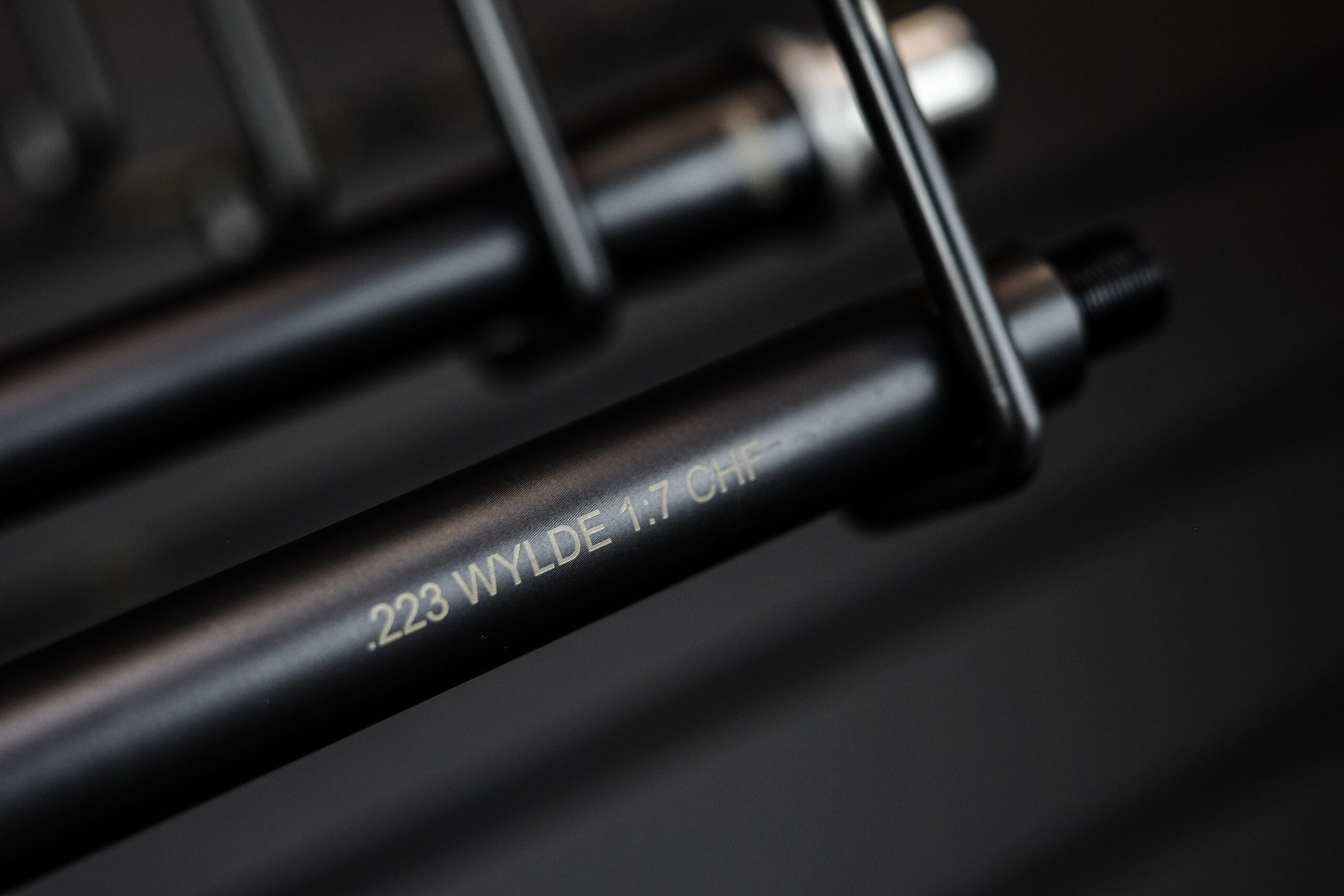
Cold Hammer Forged Barrels
Cold hammer forged barrels are some of the most popular AR 15 barrels out there, and for good reason. These barrels are generally super durable and extremely accurate. Because of this, they are often highly favored among defense and military personnel. These barrels are made by taking a large-sized barrel blank and forcing a tungsten carbide mandrel through the unfinished bore. The mandrel has the shape and cut of the rifling on it, and once in place, the blank is pounded into its final shape by very large hammers.
A common misconception about cold hammer forging is the “cold” part of the process. These barrels are usually done at room temperature. The pressure that is then generated creating these barrels does heat them up a bit, and the barrels must also be stress-relieved by further heating after forging. While this whole process can be done by heating up the barrels to extreme temperatures, today’s technology does not require it and is why it is called “cold” hammer forging.
Cold hammer forged barrels come with a big list of advantages, which is what makes them so popular. This process produces an incredibly strong barrel, and they typically have the longest lifespan when compared to other barrels. They have consistent rifling grooves and cuts, which in turn makes them very accurate. One of the biggest disadvantages to cold hammer forged barrels are how expensive the equipment is for the gun manufacturers to buy. This used to make them more expensive, but with more and more companies going to this process, prices have come down. The only other possible downside is that a high-end cut rifled barrel may be a tad bit more accurate.
Cut Rifled Barrels
Cut rifled barrels have long been considered the standard for the AR 15. It is by far the most popular and still to this day one of the most cost-effective ways to create barrels. A cut rifled barrel is created just like the name says: a barrel blank is inserted into a rifling machine, which resembles a large lathe. The machine then pushes a single cutter attached to a long rod through the rough rifle bore, carving out each groove of the rifling. This entire process can be very time consuming, but given the right technique and equipment, produces the most accurate AR 15 barrels that you can find.
Just like with the cold hammer forged barrels, cut rifled barrels have their own set of advantages and disadvantages. This process produces the most accurate AR 15 barrels that money can buy, and the manufacturing process has been fine-tuned over many years. The downsides to these barrels are that they are much more expensive to make, and if not done right, a low quality barrel will be more susceptible to accuracy issues. Overall, both hammer forged barrels and cut rifled barrels are great options for your AR 15, and either one will serve the average shooter just fine!
Types of AR 15 Barrel Steel
There are plenty of misconceptions when it comes to the actual steel used to create an AR 15 barrel. To make things a little less complicated, there are basically 7 different types of barrel steels used to make these barrels, and they can be divided into two categories: carbon and stainless steel.
Carbon barrel steels include 4140 steel, 4150 steel, and chromium-molybdenum-vanadium (CMV) which is also called 41V50. The different types of stainless barrels include 410 stainless, 416 stainless, 416r stainless, and 17-4 PH stainless. Most shooters will not want to get into the fine details about the subtle differences between each steel, but the biggest question most people ask is whether they should buy carbon or stainless for their barrels.
So, what should you get? When talking about carbon barrels, it is important to note that many of these have chrome lined bores. Chrome-lined barrels are a favorite of the military because a few things, such as their corrosion resistance, extended barrel life, and ease of cleaning. The biggest disadvantage to carbon steel barrels that are chrome lined are their long-range accuracy. While still very accurate, they are not quite as accurate as the stainless steel.
Extreme long-range shooters and competition enthusiasts will usually opt for non-chrome lined, stainless steel barrels. These are much more accurate at longer ranges, but they do wear out a little faster and are harder to clean. So, which one should you choose? It depends on what you plan to use your AR 15 for.
For most people that plan on using their AR 15 as a tool, whether that be plinking or home defense, then a carbon steel barrel, preferably chrome lined, would be the best choice. These barrels will withstand plenty of use and abuse and are much easier to care for. If you plan on using your AR 15 for precision shooting or competitions, a stainless steel barrel may be the better option for you and your needs. These will be much more accurate. Either way, both types of barrels are great and can be used for whatever you want, but just remember each have their own set of pros and cons!
Barrel Finishes
Like most guns and gun parts, AR 15 barrels are often treated with special coatings and finishes in order to help them resist corrosion and perform correctly. Even stainless steel barrels, which generally do not have any sort of treatments, can be found with finishes such as polished, satin, or bead blasted. These are just surface finishes and do not penetrate into the steel like other barrel treatments and finishes will.
The most common treatment you will see are “parkerized” barrels. This military standard is called Manganese phosphate, but falls under the umbrella name of “Parkerizing”, which is good because it is much easier to say! This is a great finish that is very protective and durable. It has served the military well for over 50 years and has proven itself along the way.
Another type of surface treatment that you might see and that is gaining popularity is ferritic nitrocarburizing, or “nitride” for short. Also sometimes referred to as melonite, the general process consists of dipping the steel in a hot bath of nitrogen salts that, like Parkerizing, produces a chemical change in the steel. It creates a smooth black finish that is very tough and extremely resistant to corrosion. But unlike Parkerizing, this process also hardens the steel and makes these nitrided barrels extremely slick, both preferred qualities in a good barrel. These nitride and melonite finishes are quickly becoming more and more popular, and provide one of the best protections for your barrel as the treatment isn’t just on the surface, but the actual steel.
AR 15 Barrel Calibers
The barrel you decide to use on your AR 15 will have to be matched to the caliber that you are wanting to shoot. The usual AR 15 platform can be chambered in many different options, such as:
- .204 Ruger
- .223 Remington
- 5.56 NATO
- .22 Nosler
- .224 Valkyrie
- .25-45 Sharps
- 6.5 Grendel
- 6.8 SPC
- .300 Blackout
- .30 Remington AR
- .350 Legend
- .450 Bushmaster
Deciding on what caliber for an AR 15 can sometimes be a bit challenging. It again comes down to your needs and intended use for the firearm. Luckily the AR 15 is incredibly modular and handle just about any job you need it for. If you want a short-barreled rifle for home defense, the AR 15 should be on your list. If you are wanting something to shoot at long range and is lightweight, the AR 15 is a great option. Even if you need a new varmint rifle for shooting at coyotes, there is a perfect AR 15 caliber for that too.
Any discussion about AR 15 calibers will no doubt start with the standard and popular 5.56 round. This round is light, fast, and has a proven track record. The .223 is essentially the same, but for civilians. There are plenty of varieties of ammunition available, and it is decently cheap. But if you want something even more accurate for accuracy or hunting, you do have some other options as well.
The .300 Blackout, for example, is a hard hitting round that was developed specifically for the AR platform. It has a very big bullet, and many are designed to stay subsonic for use through a suppressor. The downside to this caliber is the price. The rounds themselves are relatively expensive, although the barrels and parts have come down in price recently.
With so many different options in calibers, there seems to be just about a perfect AR 15 for everyone. Whether you want to a large round for hunting, a small round for precision, or something for home defense, you can probably find an AR 15 barrel for it and set up your firearm exactly how you like it.
Barrel Twists
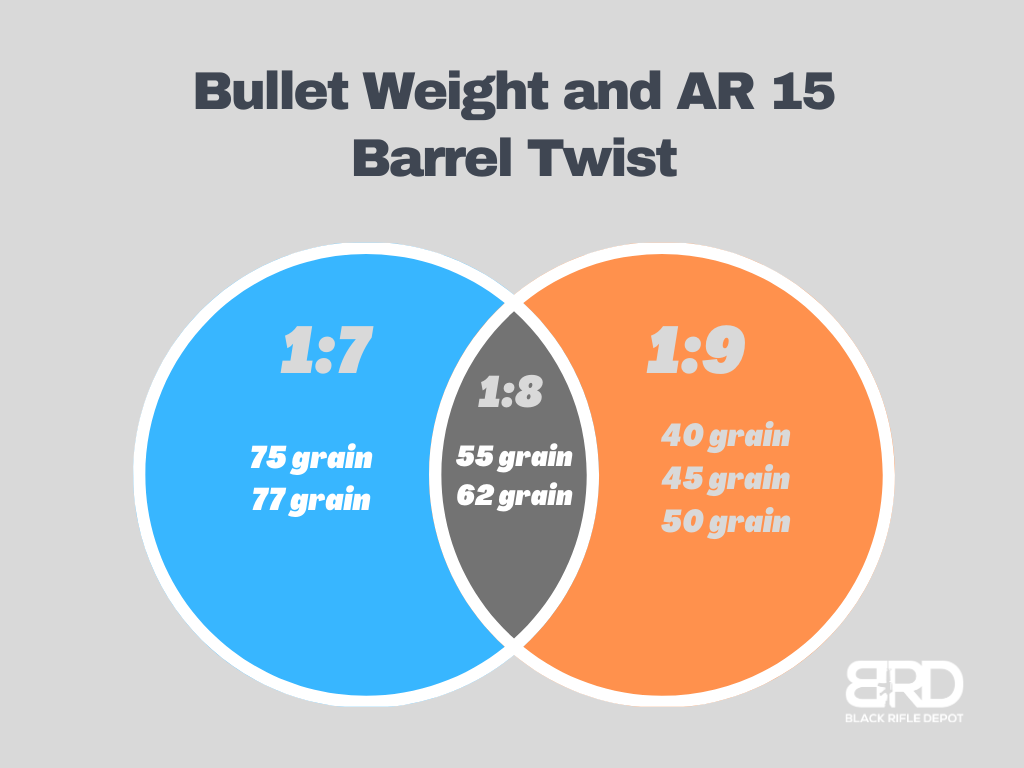
The twist rate of a barrel refers to the speed at which the rifling gives spin to a bullet. A more aggressive rifling pattern, which will have a higher twist rate, will spin and turn the bullet more and result in a faster spin rate. The entire goal of spinning a bullet is to stabilize a bullet in flight and increase its accuracy. Much like a thrown football spins while in the air, bullets must also spin in order to be as effective as possible.
Just how fast a bullet needs to spin, however, depends on a number of factors such as bullet diameter, its speed, bullet weight, and bullet construction. For the most part, if you match up the bullet types to the right barrel twist rates, you will have the most accurate shooting. For AR 15 barrels, you will often hear twist rates expressed like 1:7 or 1:9. The first number refers to a full rotation of the bullet, while the second number tells you how many inches of barrel length it needs to make that one full rotation. So, for 1:7, the bullet needs to travel 7 inches down the barrel before it completes one full rotation. In a 1:9, it is 9 inches down the barrel.
If you purchase an AR 15 in the usual 5.56mm or .223, you will most likely see a twist rate of 1:7, 1:8, or 1:9. While there are plenty of other options for twist rates available, these three are the most commonly found. While most people believe that the heavier of bullet you intend to shoot the faster the twist rate you need, this is not necessarily true. While it is a good general rule of thumb, more consideration should be put into how long the bullets are, quality of ammunition, and intended uses. Within the normal ranges that most shooters fire their rifle, bullet weight and twist shouldn’t be a concern if you have a faster than 1:7 twist rate. Quality ammunition and barrels will improve accuracy more than anything, so when choosing a twist rate, try not to overcomplicate it. In general, the longer or “heavier” the bullet you want to shoot, the faster the twist rate you will need.
Different Barrel Lengths
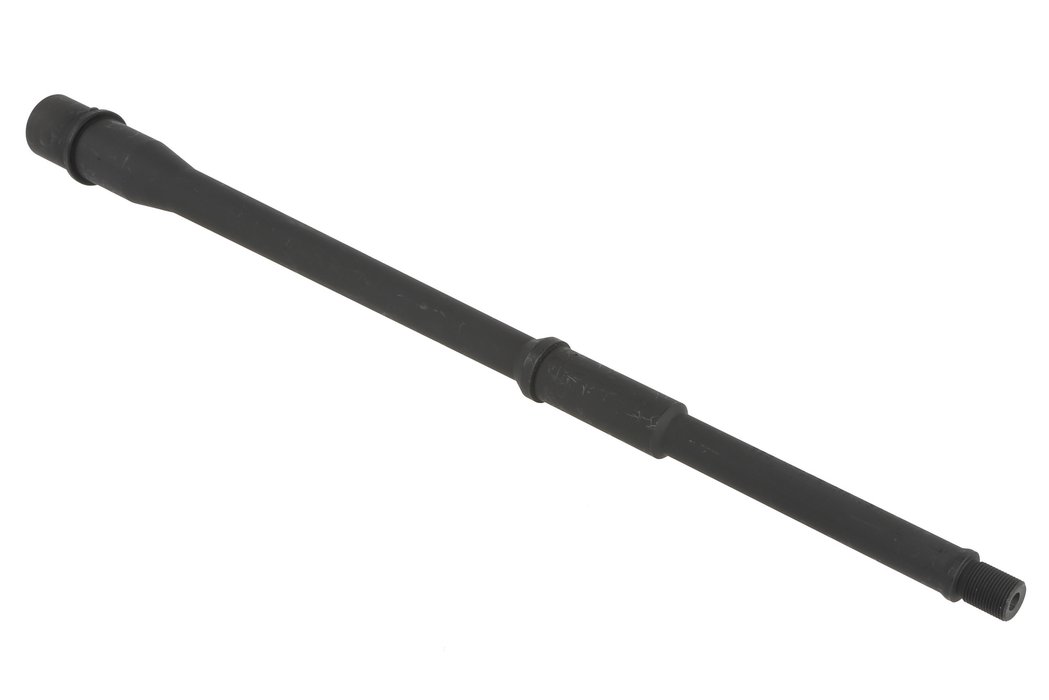
Just like anything else with an AR 15, barrel length gives you the shooter plenty of different options. There are short barrels that make your gun short and light, and longer barrels made for precision shooting, and everything in between. So what is the difference between the lengths, and what is the best choice?
Many people may say, in regard to barrel length, that the longer the better. This isn’t exactly true. While the original M16 used a 20″ barrel and but even the newer M4 rifles (and most AR 15’s) sport shorter 16″ or 14.5″ barrels that make handling and maneuverability much easier. Even these shorter barrels can be just as accurate as the longer barrels from the 20″ design.
Generally speaking, barrel length doesn’t actually affect the accuracy of a gun. It does, however, affect the velocity of the rounds you shoot. The longer the barrel on the gun, the longer the gases remain trapped behind your bullet and the more velocity your bullet will build up. So to put it plainly, the longer the barrel, the faster the bullet will go. But what does this have to do with accuracy?
The proper combination of velocity (from the built up gas) and stabilization (from the barrel rifling) is what will produce true accuracy and distance. The faster a bullet travels, the less it fights forces such as gravity and wind, making it more accurate. But just because a barrel is longer, doesn’t mean it will make a round any less accurate.
Picking the right barrel length for you and your needs will all come down to figuring out the diminishing returns. As the barrel length increases, the bullet velocity increases. But put too long of a barrel on a gun, and the bullet will still only travel as fast as it is capable of. Likewise, putting a shorter barrel on your AR will slow down your bullet, but only to a certain point. This is a gun after all, and that bullet is going to leave the chamber pretty darn fast no matter how long or short the barrel is!
On today’s market for AR 15’s, the three most common barrel lengths that you will see are 16, 18, and 20 inch variations. 20 inch barrels are slowly becoming less and less common, as they are longer, heavier, and harder to maneuver. 16 and 18 inches are the usual these days, and most new shooters are going to be very happy with a regular 16 inch barrel, or a 16″ pencil barrel for those who need lower overall weight. This gives you the most bang for your buck, providing optimal velocity while still being plenty light and short enough to enjoy using. Of course, there are also even shorter barrels on the market, but for anything shorter than 16 inches you will need a special tax stamp unless it is an AR pistol. Overall, I would gladly recommend either a 16 or 18 inch barrel to anyone wanting an AR 15.
Gas System and Tube Lengths
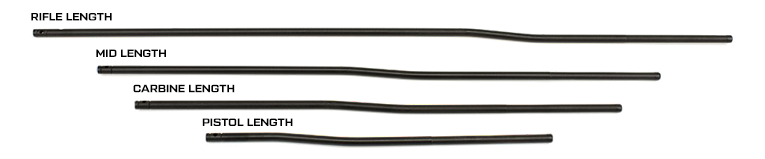
The last detail on barrels that we will touch on is the gas system. An AR 15 functions through use of a gas tube, which consists of a small hole in the barrel that vents the gas with every shot. This gas travels through the tube and into the receiver, which uses this pressure to power the bolt carrier group and cycle a new round. AR 15 generally use three different lengths when it comes to gas tubes, which are carbine, mid-length, and rifle length gas systems. So which one is the best?
Gas system lengths are going to vary on barrel lengths and preferences. For example, rifle length gas systems are generally used on 20 inch and longer barrels, mid-length on barrels 14-20 inches, and carbine length on barrels 10-18 inches.
In general, the longer the gas system, the more reliable the firearm. Many shooters will also report reduced felt recoil and muzzle climb. In general however, gas system lengths are more of a preference thing and really don’t affect the general functionality of an AR 15. Many people often choose the carbine length for its smaller size and ability to customize their firearm, while others like the mid-length due to it being a solid middle ground. There is no right or wrong choice here, so whatever seems like the best fit for you and your rifle will most likely work just fine!
Before You Buy…
While you could write an entire book on AR 15 barrels alone, hopefully this information was helpful and informative enough to make some important decisions when it comes to outfitting your AR 15 with a barrel. One of the greatest things about the AR 15 platform is its modular design and all the various options available for any individual part, including the barrels. Whether it is the barrel length, material, construction, or caliber, there are plenty of fun and unique things you can choose when buying a barrel, but the one constant is the decision to buy from your friends at Black Rifle Depot.
