
Ammo
Bulk Ammo for AR-15: Smart Buying, Storage, and Savings Tips
Dec
Table of Contents
Why stocking up sensibly matters
Ammo is the starting point for everything—hitting the range, training with friends, and maintaining a responsible, defensible supply. Buying in bulk reduces cost per round, but it also brings essential considerations around compatibility, storage, legality, and long-term value. This guide walks you through high-level, step-by-step decisions for AR-15 shooters and general buyers alike: interpreting cartridge dimensions, understanding how different calibers behave, safe storage fundamentals, and innovative strategies to save money without compromising reliability.
Buying bulk ammo: what to prioritize (quality over lowest price)
When you buy in quantity, the headline number — price per round — grabs attention. That’s fine, but the best bulk ammo purchases balance price with consistent performance. Put reliability first: pick lots from reputable manufacturers and look for specs that match your platform (for an AR-15, that usually means 5.56×45 NATO or .223 Remington-spec offerings). Check packaging dates and lot codes when possible; newer manufacture dates help avoid degraded propellant or primers. For handgun calibers commonly bought in bulk (9mm, .45 ACP, .45 Long Colt for wheelguns, and .22 LR for plinking), vendor reputation, lot consistency, and customer reviews matter as much as the per-round cost.
If you plan to run suppressed builds or precision loads, prioritize subsonic or match-grade offerings, respectively — those typically cost more but preserve point-of-impact and terminal performance. For general range practice, full-metal-jacket (FMJ) bulk packs deliver the best price per round while remaining reliable in most semi-autos.
When you compare offers, include shipping, hazmat, and any per-order limits — a great per-round price can evaporate after fees. Finally, avoid mixing lots in the same magazine during a training session if you suspect variance; mixed lots can show different cycling characteristics.
Cartridge dimensions explained — read the numbers so you get the right rounds
Understanding cartridge dimensions avoids dangerous mismatches. Below are the commonly encountered measurements and what they mean:
- Bullet diameter: the diameter of the projectile (example: 5.56×45 uses a .224-inch projectile, often written as 5.7 mm nominal).
- Case length: the brass portion of the case (for 5.56×45 NATO, 44.70–45 mm).
- Overall length (OAL): distance from the case head to the bullet tip; this controls feeding and chamber fit (5.56 OAL is commonly listed around 57.40 mm).
- Rim and base diameters: tell you what bolt and extractor geometry the case head will interface with.
- Pressure ratings / max pressure: different loadings (commercial .223 vs. 5.56 NATO) can run different pressures and require attention when chambering or hand-loading.
For example, the 5.56×45 NATO standard ammo has a case length of about 44.7 mm and an overall length of about 57.4 mm, with a bullet diameter of roughly .224 in — specs defined in technical references and standards. These numbers matter when you buy bulk 5.56 or .223 packages and when you consider hand-loading or shooting across different rifles.
For standard pistol cartridges sold in bulk: 9mm Luger uses a .355-inch projectile with a case length of 19.15 mm and a typical OAL of 29.7 mm; .45 Long Colt is a larger rimmed cartridge with a case length of 1.285 in and an OAL of 1.600 in. Exact numbers vary slightly by spec and manufacturer, so consult SAAMI or the producer when selecting bulk lots for specialized use.


Storage & rotation — keep your inventory ready and reliable
Good ammo storage preserves performance and prevents headaches. Use these practical rules:
- Store in a cool, dry place away from direct sunlight and large temperature swings. Heat accelerates chemical breakdown in propellants; moisture can corrode casings and primers.
- Use airtight, labeled containers (ammo cans with desiccant packs are ideal). Put the purchase date on every sealed case so you can rotate them by FIFO (first in, first out).
- Keep live rounds separate from reloading components — primers and powders have their own storage rules and safety considerations.
- Maintain a modest working supply at the range and keep the bulk of your purchase in long-term storage. For frequent shooters, consider keeping one or two sealed cases ready and rotating them monthly to avoid long-term stagnant storage.
- Check local fire codes for limits on how much live ammunition you can safely store at home, and always respect local ordinances.
If you plan for emergencies, consider a humidity-controlled safe or container, and remember that even well-stored modern cartridges last many years if kept cool and dry.
Savings strategies when buying bulk ammo— timing, bundles, and substitutions
To cut costs while keeping performance, use a few simple tactics:
- Buy by the case or by the pallet: case (typically 500–1,000 rounds) pricing beats more miniature packs. If you have the storage and legal ability, buying larger quantities reduces per-round cost.
- Watch seasonal sales and rebates: manufacturers and retailers run promotions around holidays, shooting events, and when inventory surges. Subscribe to dealer emails and price alerts.
- Consider generic but reputable brands: some lesser-known manufacturers produce reliable practice-grade products at considerable savings. Read a lot of reviews before ordering thousands of rounds.
- Alternate calibers for practice: for basic trigger time, inexpensive .22 LR bulk packages and steel-case 9mm offer dramatically lower per-round costs than centerfire practice loads. This preserves higher-cost rounds for drills where functionally identical ballistics matter.
- Factor in shipping and hazmat: large orders may trigger substantial shipping/hazmat fees. Sometimes multiple smaller orders timed with free-ship offers beat one huge purchase.
- Buy the right load for the purpose: don’t buy an expensive match round for high-volume dry-fire practice —you’ll waste money.
For buyers focused on AR-15 platforms, bulk 5.56 packs and case deals deliver the best balance of price and utility. If you shoot suppressed or match targets, buy smaller quantities of premium loads for those use cases and buy practice lots in bulk for fundamentals.
Caliber notes: 5.56, .223, 9mm, .22 LR, and .45 Long Colt — what you should know
Each caliber has role-based strengths when bought and stored in bulk:
- 5.56×45 / .223 Remington: The go-to for AR-15 owners. NATO-spec 5.56 and commercial .223 are similar but not identical; 5.56 often runs higher pressure and uses slightly different chamber specs. Many shooters use .223 in 5.56 chambers, but the reverse (firing 5.56 in a .223-spec barrel) can be unsafe if the rifle isn’t rated for it. Check your firearm’s chamber stamp and manufacturer guidance before bulk buying. Effective engagement distances for point targets typically fall in the few-hundred-yard range for most users, though precise distances depend on ammo and barrel length.
- 9mm Luger: Extremely common, widely available in bulk, and generally the cheapest centerfire per round. Bulk 9mm practice loads feed reliably in most pistols and carbine platforms; “barrel of 9mm bulk” often refers to buying heavy quantities by the case or “barrel” (slang for enormous quantities) to maximize savings. Cheap, brass-cased options offer the best reliability, while steel-cased packs cut costs further but may have extraction issues in some pistols.
- .22 LR: Lowest cost per shot for skill building. Bulk .22 is perfect for high-volume trigger time and is a great supplement to centerfire training. Note that most rimfire cartridges are not reloadable.
- .45 Long Colt: A classic revolver cartridge with niche bulk demand. You’ll find bulk packs for cowboy action or plinking purposes; prices and availability vary more than for 9mm or .223.
When you target inventory across your site and product pages, include cross-links to related calibers and clear guidance about platform compatibility to help buyers choose correctly.
Reloading and reuse — can you reload 5.56? (and should you?)
Hand-reloading offers significant per-round savings for frequent shooters, but it requires knowledge, time, and safe practices. You can reload 5.56/. Two hundred twenty-three cases, and many reloaders reform once-fired 5.56 brass into usable cases. Keep in mind:
- Reloading 5.56 Ammo requires the correct dies, powder recipes, and careful attention to overall length and pressure signs. Because 5.56 and .223 have different pressure specifications, use published load data and start low during development.
- Not all brass is equal: military 5.56 brass (often lacquered or berdan-primed in older lots) may be less desirable for reloading than commercial brass. Inspect and test brass before large-scale reuse.
- Safety first: never exceed published loads, use reliable reloading manuals, and consider a progressive press only after mastering single-stage fundamentals.
For most casual shooters, bulk factory practice rounds give the best time-to-value. Serious shooters and high-volume competitors commonly reload to get the lowest long-term cost and to tailor handloads for better accuracy or specific suppressor performance.
Legal, safety, and practical considerations for ammo buyers
Before you buy, think about these must-check items:
- Local restrictions: some states regulate the availability of specific projectiles (e.g., armor-piercing designs) and may have storage or transport rules. Check state laws before shipping large quantities to your address.
- Green-tip / M855: The “green tip” designation typically refers to M855-type rounds with a steel penetrator and green painted tips. While legal for many civilians under federal law, some states and ranges restrict their use. Confirm legality and range policies before buying.
- Range policies: Many indoor ranges ban steel-case or steel-core projectiles (due to splatter or damage). Verify approved rounds before hauling a trunkful of bulk purchases.
- Transport and storage: Keep cartridges in original packaging when possible, and secure them during transport. For large quantities, consider separate locked storage to limit unauthorized access.
Practical checklist before you check out
- Confirm caliber and chamber compatibility (5.56 vs .223).
- Note lot codes and manufacturing dates.
- Check shipping, hazmat, and legal restrictions for your state.
- Compare per-round cost, including fees.
- Buy a small sample lot if you’re trying a new manufacturer before committing to case quantities.
FAQ: Common Questions About Buying and Using Bulk Ammo
Buying bulk ammunition is one of the easiest ways to stretch your training budget and ensure you always have enough rounds on hand. But it also raises practical questions about safety, storage, caliber compatibility, and how to get the best value for your needs. The answers below break down these essentials in a straightforward way so you can shop—and shoot—with confidence.
Is 5.56 suitable for both military and civilian use?
Yes. The 5.56×45 cartridge was developed for military rifles but is fully available for civilian shooters in both 5.56 NATO and .223 Remington loadings. As long as your rifle is chambered for it, you can safely use it for range practice, training, hunting, or defense.
What makes 5.56×45mm so popular among military and law enforcement users?
Its popularity comes from a combination of lightweight cartridges, manageable recoil, and flat trajectory. The round allows soldiers and officers to carry more ammunition without sacrificing effectiveness, making it ideal for fast, accurate follow-up shots.
What is “green tip” 5.56 ammunition?
Green tip refers to M855-style rounds with a small steel penetrator in the bullet’s core, marked by a green-painted tip. These rounds were designed for improved barrier penetration. They’re legal in most areas but are sometimes restricted at indoor ranges, so always check local regulations.
Can I use 5.56 ammunition for hunting?
Yes. Modern 5.56 loads with expanding or soft-point bullets are effective for small to medium game such as coyotes and hogs. For ethical results, choose purpose-built hunting rounds and keep shots within practical ranges (usually under 300 yards).
What types of 5.56 ammunition are available?
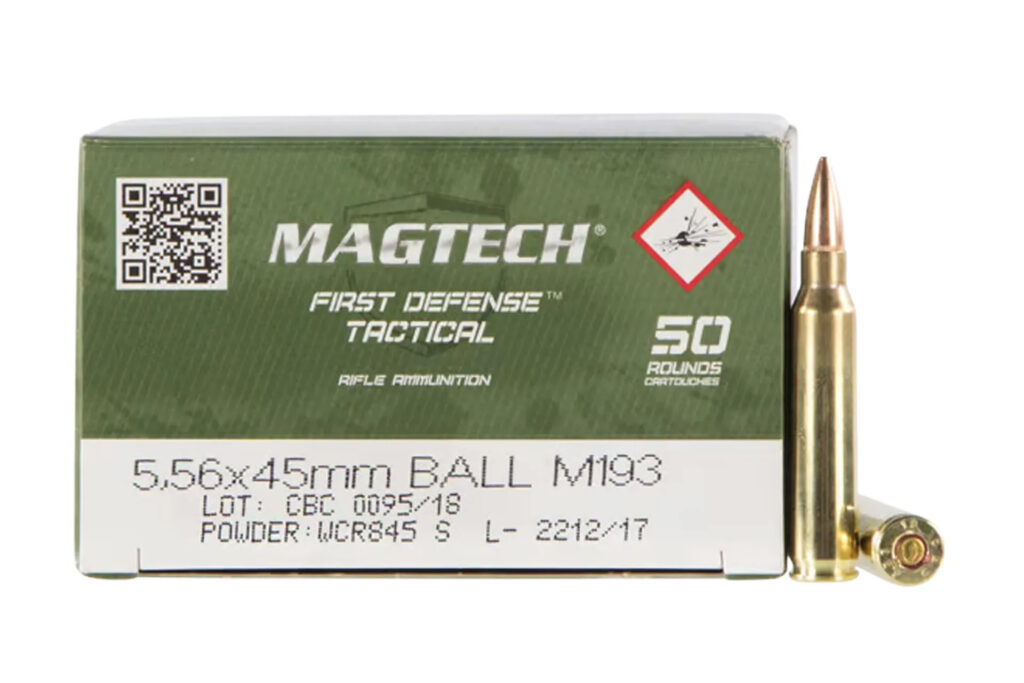
Common types include M193 (55-grain FMJ), M855 or “green tip” (62-grain penetrator), M856 tracer rounds, and various match or polymer-tipped designs for precision and hunting. Each has a specific purpose—training, defense, or target work—so choose based on your goal.
Can civilians legally buy and use 5.56 ammunition?
Absolutely. In most states, 5.56 cartridges are sold freely to civilian shooters. However, specific states or municipalities regulate armor-piercing or tracer rounds. Always verify your local laws before ordering in bulk.
Can I reload 5.56 cases to save money?
Yes, 5.56 brass can be reloaded multiple times if inspected and prepared correctly. You’ll need reloading dies, powder, primers, and verified load data. Reloading saves money for high-volume shooters, but safety and precision must come first—start with published data and follow best practices.
What’s the effective range of 5.56 ammunition?
In general, most 5.56 rifles perform best between 100 and 300 yards for practical accuracy and terminal effect. With the right barrel, optics, and match-grade ammunition, skilled marksmen can push well beyond that range on paper targets, though effectiveness on live targets diminishes past a few hundred yards.
Buy smart, store smart, and save without sacrificing reliability.
Buying in bulk is a smart move when you balance price with function, storage, and legal factors. For AR-15 owners, buying quality 5.56 packs and rotating stock keeps training affordable and reliable. For general shooters, mixing inexpensive practice rounds (.22 LR, bulk 9mm) with purpose-built centerfire packages for defense or hunting gives the best of both worlds.
Ready to stock up the right way? Visit the ammunition section at Black Rifle Depot to explore case deals, manufacturer spec sheets, and curated bundles tailored to AR-15 owners and general shooters. Our team can help you choose the correct cartridge dimensions and storage options for your needs with quick shipping and expert guidance.
For additional resources, check out our Facebook Page.
