
AR-15 Complete Uppers
M16A1 Upper vs Modern AR-15: What’s the Difference?
Apr
Table of Contents
If you spend enough time shopping for upper receivers, you start to notice two very different worlds inside the AR platform. One world is all about modern features like flat-top rails, optics-ready setups, free-float handguards, and modular accessories. The other is built around the classic look of the M16A1 upper, with its fixed carry handle, simple sighting system, and unmistakable retro profile. Both have their place, but they are not the same thing.
That is why this comparison matters. A lot of shooters see an M16A1 upper receiver and assume it is just an older version of a modern AR-15 upper. In reality, the differences go beyond age and appearance. The receiver design changes how the rifle handles optics, how it looks, how it feels in the hands, and even what kind of build makes the most sense around it.
For some buyers, the M16A1 upper is about nostalgia and period-correct style. For others, it is about simplicity. There is a clean, practical appeal to a fixed-carriage-handle rifle with iron sights and a more traditional layout. On the other side, modern AR-15 uppers are designed for flexibility. They are easier to adapt for red dots, LPVOs, lights, lasers, and a long list of other accessories that many shooters now consider standard.
So what is the real difference? It comes down to purpose. The M16A1 upper reflects a different era of rifle design, while the modern AR-15 upper reflects how most shooters set up rifles today. Neither is automatically right for everyone. The better choice depends on what kind of rifle you want to build and how you plan to use it.
What is an M16A1 upper?
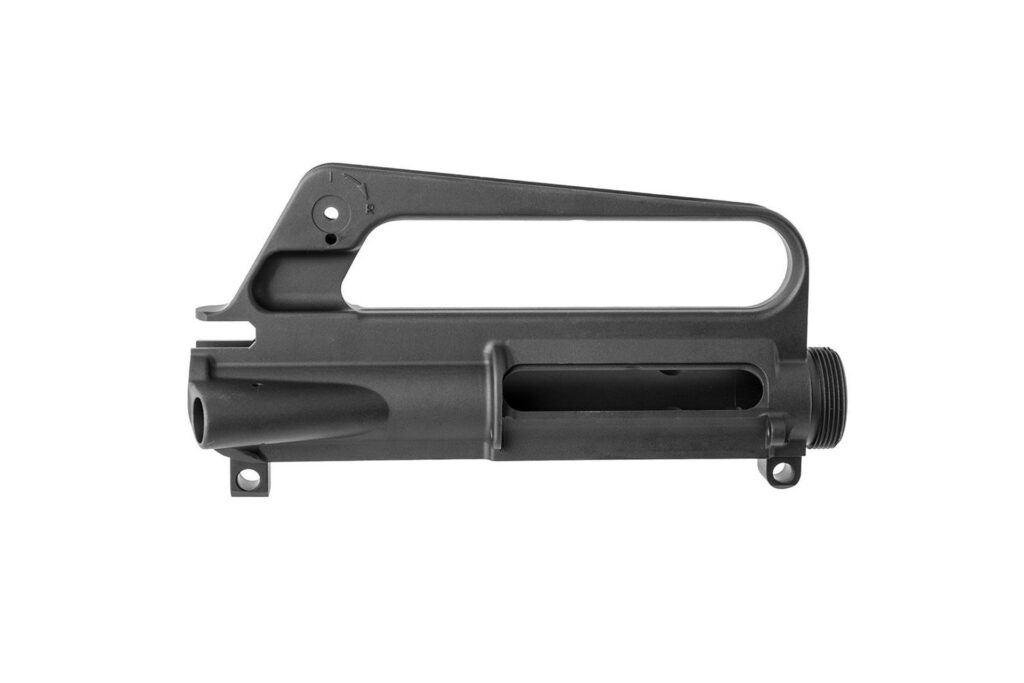
An M16A1 upper is a classic upper receiver pattern modeled after the upper used on the M16A1 rifle. The most recognizable feature is the fixed carry handle, which is built directly into the receiver. Unlike a modern flat-top upper, the rear sight is part of the upper itself rather than mounted separately. That fixed-handle design gives the M16A1 its instantly recognizable silhouette and its old-school shooting feel.
Another defining characteristic is its connection to the classic rifle-length setup. When most shooters picture an M16A1-style build, they imagine a 20-inch barrel, slim handguards, iron sights, and a lightweight retro profile. Even when modern builders incorporate newer parts, the upper still anchors the rifle in that classic style.
The M16A1 upper is popular for more than just looks. Many shooters enjoy the straightforward nature of the design. You are not building around endless accessory options. You are building around the rifle itself. That appeals to retro enthusiasts, clone builders, collectors, and anyone who appreciates the roots of the AR platform.
What defines a modern AR-15 upper?
A modern AR-15 upper is built around modularity. The biggest visual and functional change is the flat-top receiver. Instead of a fixed carry handle, you get a Picatinny rail across the top, which makes it easy to mount optics and backup sights in whatever configuration works best for you.
That design change opened the door for the way most AR-15s are set up today. Red dots, holographic sights, prism optics, LPVOs, magnifiers, and night vision accessories all fit far more naturally on a flat-top upper. Modern uppers are often paired with free-float handguards, M-LOK accessory slots, various barrel lengths, different gas system lengths, and other features that make the rifle easier to tailor to a specific role.
A modern AR-15 upper can be set up for home defense, range use, training, hunting, competition, or all-around general-purpose shooting. That flexibility is a major reason flat-top uppers dominate the market. Instead of locking the shooter into a single sighting system and a single rifle style, the modern upper gives you options.


The biggest difference is the receiver layout
If you want the simplest answer possible, the real difference starts with the receiver itself.
The M16A1 upper receiver uses a fixed carry handle with built-in rear sights. A modern AR-15 upper usually uses a flat-top rail. That one design difference shapes almost everything else about the build.
With the M16A1 upper, the rifle naturally leans toward a traditional setup. The sights are built in. The carry handle is permanent. The upper has a cleaner, more classic profile, but it also gives you fewer easy options for changing the sighting system. The upper encourages a rifle that stays closer to its roots.
With a modern flat-top upper, the rifle becomes much more adaptable. You can mount a red dot today, swap to a low-power variable optic later, and add folding backup sights without much trouble. The upper is designed to work with current shooting preferences rather than a fixed iron-sight system.
That does not mean the M16A1 design is outdated or useless. It means it is focused. It does one thing well, and it appeals to shooters who want that specific experience. Modern uppers simply cast a wider net.
Sights and optics are where the gap gets obvious
For many shooters, the decision comes down to sights.
The M16A1 upper is rooted in iron-sight shooting. That is part of the appeal. A fixed carry handle gives the rifle a traditional sight picture and classic look that many builders actively want. If your goal is a retro rifle or a clone-inspired setup, the fixed carry handle is not a drawback. It is one of the main reasons to choose that upper in the first place.
The trade-off is optic mounting. You can mount optics on some carry handle setups, but it is far less convenient than using a flat-top receiver. The optic position may be less than ideal, and the overall setup is not as streamlined as that of a modern upper.
A modern AR-15 upper makes optic mounting simple. Most current shooters want a red dot, LPVO, or some kind of magnified optic, and the flat-top receiver supports all of them without compromise. If your rifle is meant to be a modern defensive, training, or do-it-all carbine, the flat-top upper makes much more sense.
This is one of the clearest dividing lines between the two. The M16A1 upper favors tradition. The modern upper favors flexibility.
Barrel length and overall feel
While the upper receiver itself is the focus, the style of the upper often points toward a particular barrel setup.
The M16A1 is most commonly associated with a 20-inch rifle-length configuration. That longer setup gives the rifle a smooth recoil impulse, longer sight radius, and classic full-size balance. Many shooters still enjoy the way a rifle-length gun feels compared to shorter carbines. It has a steadier, more traditional character that stands out once you handle one.
Modern AR-15 uppers come in a much wider range of barrel lengths. Sixteen-inch uppers are especially common, but there are many other options depending on the role of the rifle. That variety is part of the appeal. A modern upper can be lightweight and compact, stretched into a precision role, or built as a balanced general-purpose setup.
The M16A1 upper tends to guide the builder toward a specific rifle style. A modern upper leaves the door open for many styles. That is not a flaw in the M16A1 design. It is simply a reflection of what it was made to be.
Build style and intended use
This is where the choice becomes more personal.
If your goal is a retro build, the M16A1 upper makes a lot of sense. It gives the rifle the right profile and the right character. It feels more authentic, looks right, and captures the old-school style that many collectors and longtime AR fans appreciate. Some shooters also enjoy the challenge and satisfaction of running a more stripped-down rifle with fixed sights and fewer accessories.
If your goal is a practical rifle for today’s shooting environment, a modern AR-15 upper is usually the better tool. It is easier to configure, upgrade, and adapt to changing needs. Whether you want a red dot for fast shooting, a magnified optic for distance, or a light for low-light use, the flat-top upper supports it all far better than a fixed carry handle design.
In other words, the M16A1 upper is often chosen because the shooter wants that rifle. A modern upper is often chosen because the shooter wants options.
Are M16A1 uppers compatible with modern AR-15 lowers?
In most cases, yes. One reason retro builds remain popular is that the AR platform offers strong parts compatibility across generations. An M16A1-style upper can generally be paired with a modern semi-auto AR-15 lower, allowing shooters to build a retro-inspired rifle without needing every part to be vintage or hard to source.
That compatibility is great for enthusiasts who want the classic look without giving up the convenience of using currently available lower parts, triggers, furniture, and controls. You can create a rifle that captures the spirit of the original style while still using dependable modern components where appropriate.
Still, compatibility should not be confused with perfect aesthetic or historical accuracy. A true retro build often requires more than just dropping an M16A1 upper onto any lower you have lying around. If appearance matters, details like stock style, grip, barrel profile, handguards, and finish all play a role.
Why some shooters still prefer the M16A1 upper today
It would be easy to assume that most buyers choose an M16A1 upper for pure nostalgia, but that is only part of the story.
Yes, retro appeal matters. The fixed carry handle, classic lines, and old-school rifle profile are a huge part of the attraction. But there is also a practical side to the preference. Some shooters genuinely like the simplicity. They do not want a rifle loaded down with accessories. They want something clean, straightforward, and enjoyable to shoot.
There is also something satisfying about a rifle that feels complete without needing a long list of upgrades. A modern AR-15 upper can sometimes feel like the starting point for more parts and more decisions. An M16A1 upper feels more finished from the beginning. That makes it appealing to shooters who value traditional handling and a less cluttered setup.
For others, it is about variety. If you already own a few modern flat-top ARs, building a retro rifle around an M16A1 upper adds something different to the collection. It gives you a new experience without leaving the AR platform.
Which one should you buy?
The answer depends on your goal.
Buy an M16A1 upper receiver if you want a retro-inspired rifle, appreciate fixed sights, like the classic carry handle profile, or simply want something different from the typical flat-top AR-15. It is a strong choice for clone-style builds, collectors, and shooters who enjoy the platform’s old-school feel.
Buy a modern AR-15 upper if you want easy optic mounting, broader accessory support, and a rifle that is ready for the way most shooters configure carbines today. If your rifle is meant to be highly adaptable, a flat-top upper will almost always be the easier path.
This is not really a question of old versus new in a simple sense. It is a question of classic versus versatile. The M16A1 upper still has real value because it offers a distinct rifle experience. Modern uppers dominate because they make customization easier. Both can be excellent when matched to the right build.
FAQ
Here are a few common questions shooters ask when comparing the M16A1 upper to a modern AR-15 upper.
What is an M16A1 upper receiver?
An M16A1 upper receiver is a classic-style upper known for its fixed carry handle and built-in rear sight. It is modeled after the upper used on the M16A1 rifle and is popular for retro AR builds.
What is the difference between an M16A1 upper and a modern AR-15 upper?
The biggest difference is the receiver design. An M16A1 upper uses a fixed carry handle and built-in sights, while a modern AR-15 upper usually has a flat-top rail that makes it easier to mount optics and accessories.
Does an M16A1 upper have a forward assist?
Yes, the traditional M16A1 upper is associated with the addition of a forward assist, which became one of the key features separating it from earlier versions of the platform.
Are M16A1 uppers compatible with modern AR-15 lowers?
In most cases, yes. Many M16A1-style uppers can be used with modern AR-15 lowers, which is why retro-style builds are still very popular today.
Why do some shooters prefer M16A1 uppers today?
Many shooters like the classic look, fixed carry handle, and simpler rifle setup. Others want to build retro clones or just enjoy something different from the modern flat-top AR-15 style.
What barrel length is standard on an M16A1 upper?
The classic M16A1 rifle setup is most commonly associated with a 20-inch barrel, which helps create the traditional full-length rifle feel.
Do M16A1 uppers use fixed carry handles?
Yes. That is one of their defining features. The carry handle is part of the upper receiver itself rather than a removable piece.
Can you mount optics on an M16A1 upper receiver?
Yes, but it is not as convenient as mounting optics on a modern flat-top upper. Fixed carry handle uppers are much better suited to iron-sight use or retro-style optic setups.
Is an M16A1 upper good for modern shooting or just retro builds?
It can still be used for modern shooting, but it is best suited for shooters who want a traditional iron-sight setup or a retro-inspired rifle. For the easiest optic use and accessory mounting, a modern upper is usually the better option.
Where can you buy an M16A1 upper receiver online?
You can find AR-15 upper receivers and build components online through trusted firearm parts retailers. If you are comparing upper options for your next build, Black Rifle Depot is a strong place to start.
Final thoughts
The real difference between an M16A1 upper and a modern AR-15 upper is not just appearance. It is the philosophy behind the build. The M16A1 upper is rooted in simplicity, tradition, and the classic fixed-carry-handle layout that helped define the rifle platform for generations. A modern AR-15 upper is built around flexibility, optic compatibility, and the freedom to configure the rifle for almost any role.
That is why neither option is automatically better across the board. If you want a retro character, classic styling, and a more traditional shooting setup, the M16A1 upper delivers something modern flat-top builds cannot quite replicate. If you want modularity and a rifle that can evolve with your needs, a modern AR-15 upper is the more practical choice.
Whether you are putting together a retro-inspired rifle or upgrading a current build, the key is choosing the upper that matches your goals from the start. If you are ready to shop for quality AR-15 upper receivers and parts, Black Rifle Depot is a solid place to start your build with components that fit both classic and modern directions.
For additional support, check out our Instagram page.
