
AR-15 Gas System
AR-15 Gas System Lengths Explained: Pistol, Carbine, Mid & Rifle
Oct
Table of Contents
The AR-15 gas system plays a major role in how the rifle cycles, how quickly the action moves, and how the firearm feels during use. While many shooters focus primarily on barrel length, handguards, triggers, optics, and muzzle devices, the gas system is one of the most important mechanical systems inside a direct-impingement AR-15.
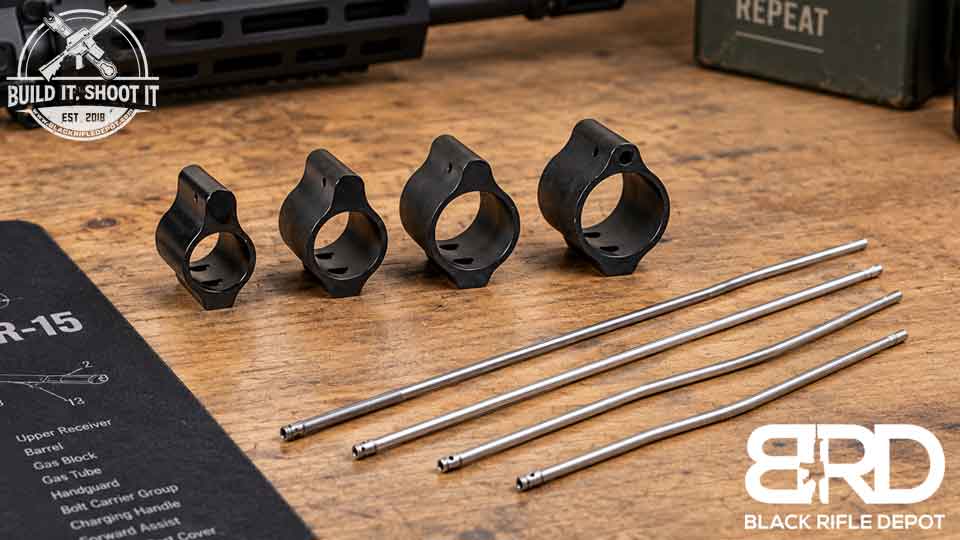
Most AR-15s use one of four common gas system lengths: pistol, carbine, mid-length, or rifle. Each system positions the gas port at a different distance from the chamber, changing the pressure and dwell time available to cycle the action.
Understanding these differences can help when choosing a barrel, replacing an AR-15 gas tube, selecting an AR-15 gas block, troubleshooting cycling behavior, or deciding whether an adjustable gas block makes sense for a particular build. This guide breaks down the four primary gas system lengths, explains how gas blocks and tubes work together, and covers common gas block journal sizes such as .625 and .750 inch.
How an AR-15 Gas System Works
A traditional direct-impingement AR-15 uses gas generated when a cartridge is fired to cycle the action. As the bullet travels down the barrel, it passes a small opening called the gas port. A portion of the expanding gas enters this port and flows through the gas block into the gas tube.
The gas then travels rearward through the upper receiver and interacts with the bolt carrier group, initiating the cycling process. The bolt carrier moves rearward, allowing the rifle to extract and eject the fired case. The recoil spring then pushes the carrier forward again, loading the next cartridge into the chamber.
That basic process is the same regardless of whether the rifle uses a pistol, carbine, mid-length, or rifle-length system. What changes is the gas port location and the corresponding gas tube length for AR-15 applications.
The distance between the chamber and gas port affects pressure and dwell characteristics. That is why gas system length can influence reliability, recoil feel, bolt speed, and overall cycling behavior.
What Are the Four AR-15 Gas System Lengths?
The four primary AR-15 gas system lengths are pistol, carbine, mid-length, and rifle. These names refer to the gas port’s approximate position, not the overall barrel length.
A shorter gas system places the gas port closer to the chamber, where gas pressure is generally higher. A longer system places the gas port farther down the barrel, where pressure has dropped before entering the operating system.
The correct configuration depends on the barrel, gas port dimensions, ammunition, buffer system, and intended use. While certain gas system lengths commonly pair with certain barrel lengths, no single arrangement applies to every AR-15.
Pistol-Length Gas System
A pistol-length gas system places the gas port closest to the chamber among the four standard configurations. It is most commonly used on short-barreled AR configurations where a longer gas system would not leave enough barrel length beyond the gas port to function properly.
A pistol-length gas tube is typically around 6.75 inches long, although exact dimensions can vary slightly by manufacturer. Because the gas port sits relatively close to the chamber, the system is exposed to higher gas pressure than longer configurations.
This can result in a more aggressive cycling impulse depending on the barrel, ammunition, suppressor use, gas port size, and buffer setup. Barrel manufacturers compensate for these factors through port sizing and overall system design.
For short AR builds, an AR-15 adjustable gas block may help when you want more control over gas flow. This can be especially relevant when the firearm is suppressed or when the shooter is trying to reduce excessive bolt speed.
Carbine-Length Gas System
The carbine-length gas system has been one of the most common AR configurations for decades. It was developed to support shorter barrels while maintaining reliable operation and became especially popular on 14.5-inch and 16-inch rifles.
A typical carbine-length gas tube measures approximately 9.75 inches. Compared with a pistol-length system, the gas port sits farther from the chamber, so the pressure entering the system is somewhat lower.
Carbine-length systems remain popular because of their long service history, widespread parts availability, and compatibility with many barrel configurations. They can also be very reliable when paired with an appropriate gas port, buffer weight, and recoil spring.
Shooters comparing a carbine-length vs. mid-length gas system often focus on differences in gas port location and cycling characteristics. A carbine gas system usually runs at higher port pressure than a mid-length system on the same barrel length, though exact behavior depends on the rest of the rifle.
Mid-Length Gas System
The mid-length gas system sits between carbine and rifle-length configurations. It has become especially popular on 16-inch AR-15 barrels because it places the gas port farther forward while still leaving enough barrel length beyond the port for reliable operation.
A typical mid-length gas tube measures around 11.75 inches. The longer distance between the chamber and gas port means the gas enters the system at lower pressure than in a comparable carbine setup.
One of the main reasons shooters prefer mid-length systems is that they can cycle more smoothly when properly matched to the barrel and buffer system. That does not mean every mid-length setup is automatically softer or more reliable, but the configuration often gives manufacturers more room to balance gas pressure and timing on 16-inch barrels.
For many modern 16-inch AR builds, mid-length gas has become a very common choice. It offers a useful balance between reliability, cycling behavior, and component longevity.
Rifle-Length Gas System
A rifle-length gas system places the gas port farther from the chamber than the other standard configurations. It is most commonly found on longer barrels, especially 18-inch and 20-inch rifles.
A standard rifle-length gas tube measures approximately 15.125 inches. Because the gas port sits farther down the barrel, the pressure entering the system is lower than with shorter gas system lengths.
When properly configured, rifle-length systems are known for smooth cycling and consistent operation. The original full-length AR-15 and M16-style rifles helped establish this setup as the traditional configuration for 20-inch barrels.
Rifle-length systems are still common on precision-oriented builds, traditional rifle setups, and longer-barreled AR configurations where a shorter gas system isn’t necessary.
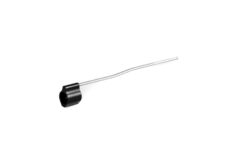

Carbine Length vs Mid Length Gas System
The carbine length vs. mid-length gas system comparison is one of the most common decisions for shooters buying or building a 16-inch AR-15. The key difference is where the gas port sits on the barrel.
A carbine gas port sits closer to the chamber, while a mid-length gas port sits farther forward. That difference changes the pressure present when gas enters the system and affects how the rifle cycles.
A well-designed carbine gas system can be extremely reliable and has been used successfully for decades. Mid-length systems, however, have become increasingly popular on 16-inch barrels because they can offer a smoother operating impulse when the rest of the rifle is properly balanced.
Neither system is automatically better in every situation. Barrel gas port size, ammunition, buffer weight, spring rate, suppressor use, and carrier mass all influence cycling behavior.
AR-15 Gas Blocks Explained
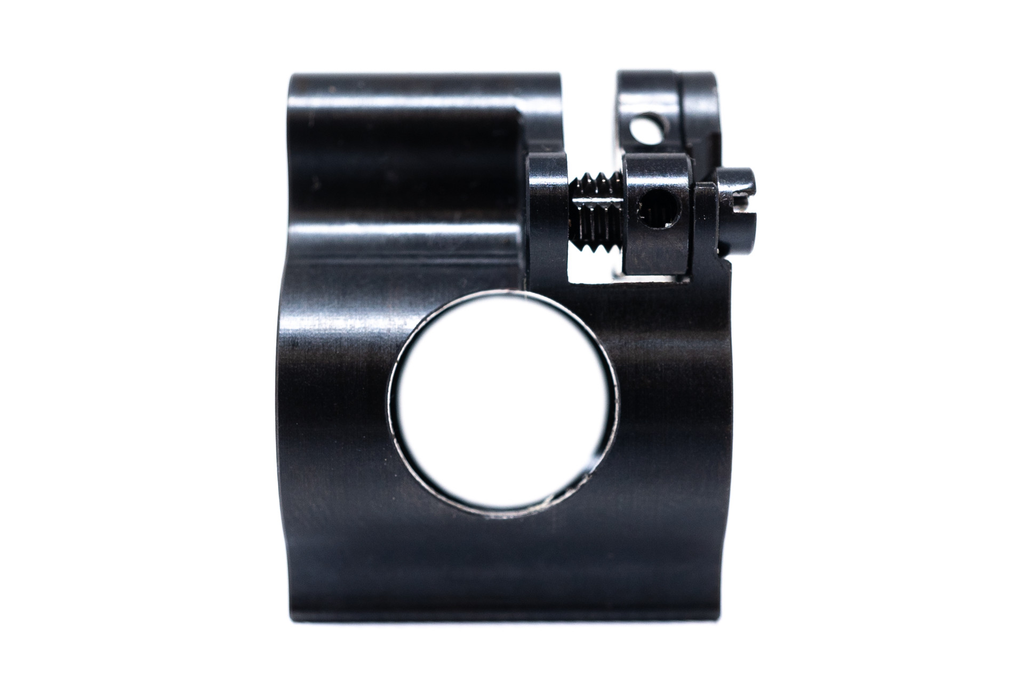
The gas block mounts around the barrel and aligns with the barrel’s gas port. Its job is to capture gas leaving the barrel and direct that gas into the gas tube.
A standard AR-15 gas block lets the rifle operate based on the barrel’s gas port size and the rest of the system. These fixed gas blocks are simple, durable, and commonly used on general-purpose builds.
Gas blocks are available in different styles, including traditional front sight base designs, low-profile fixed blocks, and adjustable models. The correct choice depends on the barrel, handguard, and how much control the shooter wants over gas flow.
AR-15 Low Profile Gas Blocks
An AR-15 low-profile gas block fits underneath most modern free-float handguards. This style has become extremely common as free-float rails have largely replaced older front sight base setups on many AR builds.
Low-profile gas blocks are available in both fixed and adjustable designs. They are typically secured with set screws or clamps, depending on the model.
The most important compatibility factor is the barrel’s gas block journal diameter. Even if the handguard has plenty of clearance, the gas block still has to match the barrel’s outside diameter where it mounts.
Why Use an Adjustable Gas Block?
An adjustable gas block allows the shooter to control how much gas enters the operating system. Instead of letting the full volume of gas flow through the block, you can reduce the gas supply to better match the rifle’s needs.
An AR-15 adjustable gas block can be useful on suppressed rifles, competition builds, or firearms that are noticeably over-gassed. Reducing excess gas can help control bolt speed and may improve the rifle’s overall feel.
Shooters looking for the best adjustable gas block should consider durability, adjustment range, ease of access, installation method, and compatibility with the barrel and handguard.
Different designs use different adjustment systems. Some rely on small screws, while others are designed to make adjustments easier without removing the handguard.
RifleSpeed Adjustable Gas Blocks
The RifleSpeed adjustable gas block is a well-known option for shooters who want easier access to gas adjustments. Instead of a small recessed adjustment screw, the system uses an externally adjustable control.
A RifleSpeed gas block can be especially useful for shooters who regularly switch between suppressed and unsuppressed use or between ammunition types that produce noticeably different operating characteristics.
As with any gas block, fitment still depends on barrel diameter, handguard clearance, gas system length, and other build dimensions. The adjustment method may be convenient, but the rest of the system must still be compatible.
Is a .750 Gas Block the Most Common Size?
For many modern AR-15 barrels, .750 inch is the most common gas block journal diameter. That makes a .750 adjustable gas block or fixed .750 block one of the most widely available options.
However, .750 is not the only size used on AR barrels. Different barrel profiles can use different journal diameters.
Common gas block sizes include:
- .625 inch
- .750 inch
- .875 inch
- .936 inch
Before purchasing any gas block, always verify the diameter of the barrel’s gas block journal.
.625 vs .750 Gas Blocks
The difference between .625 and .750 gas blocks is simply the diameter of the barrel section they fit. A .625 gas block fits a .625-inch journal, while a .750 gas block fits a .750-inch journal.
You often find smaller .625 journals on lightweight or pencil-profile barrels. The .750 size is common on government-profile and many medium-profile barrels.
Neither size is inherently better than the other. The correct gas block matches the barrel.
A gas block with the wrong internal diameter will not fit correctly, so always confirm compatibility before ordering.

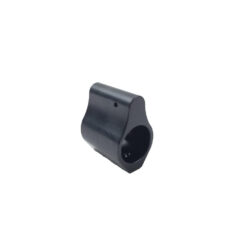
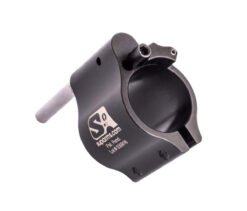
How to Measure AR-15 Gas Block Size
The easiest way to determine gas block size is to check the barrel manufacturer’s specifications. Most manufacturers list the gas block journal diameter in the barrel description or technical specifications.
If that information is unavailable, measure the barrel at the gas block journal with a precision caliper. Take the measurement at the section of the barrel where the gas block sits.
A measurement of approximately .750 inch indicates the barrel requires a .750 gas block. A measurement closer to .625 inch indicates a .625 block.
Do not rely only on visual appearance. Different barrel profiles can look very similar even though the gas block journals are different sizes.
Choosing the Correct AR15 Gas Tube
The gas tube must match the gas system length built into the barrel. A pistol-length barrel requires a pistol-length tube, a carbine barrel requires a carbine-length tube, and the same rule applies to mid-length and rifle-length systems.
Choosing the wrong AR-15 gas tube can prevent the gas system from aligning or functioning properly. The tube has to extend from the gas block to the upper receiver at the correct length.
Because gas tubes are relatively inexpensive, people often replace them during rebuilds or when changing a gas block. Even so, correct sizing remains essential.
Before ordering a replacement gas tube for AR-15 applications, confirm the gas system length specified by the barrel manufacturer.
Gas System Length and Barrel Length
Gas system length and barrel length are related, but they are not the same thing. Two barrels with the same overall length can use different gas systems.
For example, many 16-inch barrels are available in both carbine and mid-length configurations. The barrel manufacturer determines the gas port location when it produces the barrel.
Likewise, shorter barrels often use pistol-length systems, while longer barrels may use mid-length or rifle-length systems.
You cannot change a barrel from one gas system length to another simply by installing a different gas tube. The gas port itself must be located in the correct position on the barrel.
Gas System Dwell Time
Dwell time refers to the period between the bullet passing the gas port and the bullet exiting the muzzle. During that brief period, gas pressure continues to feed the operating system.
A barrel with more length beyond the gas port generally has more dwell time than one with less barrel remaining after the port. This is one reason barrel length and gas system length have to be considered together.
Too much or too little effective gas can influence cycling behavior. Manufacturers balance dwell time with gas port size to create a reliable system.
This is also why two rifles with the same gas system length can behave differently if the barrels use different gas port dimensions or lengths.
Direct Impingement vs Gas Piston Systems
Most AR-15s use a direct-impingement-style operating system. In these rifles, gas travels from the barrel through the gas block and tube and then acts on the bolt carrier group.
Some AR-style firearms use a gas piston system instead. In a piston-operated design, gas acts on a piston near the gas block, and that piston transfers energy to the action.
Piston systems require specialized parts and are not directly interchangeable with standard gas tube setups. They may use different gas blocks, operating rods, bolt carriers, and handguard requirements.
Both systems can be reliable when properly designed, but traditional direct-impingement systems remain the most common configuration for the AR-15.
AR-10 Gas System Considerations
Large-frame AR rifles introduce additional compatibility considerations. Unlike the AR-15 platform, AR-10-style rifles do not follow a universal dimensional standard across manufacturers.
Therefore, check an AR10 adjustable gas block, gas tube, barrel, and buffer system carefully for compatibility before installation.
Gas block journal diameters such as .750 and .875 are common on large-frame rifles, but you should never assume those measurements. Barrel specifications should always be confirmed.
This is especially important when mixing components from different manufacturers.
How Buffer Weight Affects the Gas System
The buffer system works directly with the gas system to control how the rifle cycles. When gas pushes the bolt carrier rearward, the buffer and spring resist that movement and return the carrier forward.
A heavier buffer can slow the carrier slightly and change how the rifle feels during cycling. In some over-gassed rifles, increasing buffer weight can help manage excessive bolt speed.
However, buffer weight should not replace correcting a major gas issue. View the gas system and buffer system as parts of the same operating cycle.
Changes to one side of the system can affect the other.
Suppressors and Gas System Behavior
Adding a suppressor can increase back pressure and send more gas through the operating system. Depending on the rifle, this may increase bolt speed and make the rifle feel more aggressively gassed.
This is one reason adjustable gas blocks are popular on suppressed builds. Reducing gas flow can help offset some of the additional pressure created by the suppressor.
A heavier buffer or different spring can also influence cycling, but there is no one-size-fits-all setup. Barrel length, gas port size, suppressor design, ammunition, and carrier weight all matter.
For rifles that switch frequently between suppressed and unsuppressed use, an easily adjustable gas block may offer added flexibility.
Matching the Gas System to the Rest of the Rifle
The gas system does not operate independently. Several components work together to determine how the AR cycles.
Important factors include:
- Barrel length
- Gas port size
- Gas system length
- Gas block
- Gas tube
- Bolt carrier group
- Buffer weight
- Buffer spring
- Ammunition
- Suppressor use
Changing one component can influence the behavior of the entire system. That is why diagnosing cycling problems often requires looking at the rifle as a complete system rather than focusing on a single part.
A properly matched setup should provide enough gas to cycle reliably without unnecessarily stressing the action.
Final Thoughts on AR-15 Gas Systems
Understanding the AR-15 gas system makes it easier to choose compatible components and better understand how a rifle cycles. Pistol, carbine, mid-length, and rifle systems all perform the same basic function, but their gas port locations affect pressure, timing, and overall operating characteristics.
For most builders, the most important step is matching the barrel’s existing gas system length and gas block journal size. From there, you can choose between fixed and adjustable gas blocks, select the correct gas tube, and make sure the rest of the operating system is properly matched.
Whether you need an AR-15 gas block, replacement gas tubes, a low-profile block, or an adjustable setup, Black Rifle Depot carries a wide selection of AR-15 gas system components for new builds, upgrades, and replacement projects.
AR-15 Gas System FAQ
Understanding gas system length and gas block sizing makes it much easier to choose compatible parts. Here are answers to some of the most common questions about AR-15 gas systems.
What are the four AR-15 gas system lengths?
The four primary AR-15 gas system lengths are pistol, carbine, mid-length, and rifle. The names refer to the approximate position of the gas port along the barrel.
What is the difference between pistol and carbine gas systems?
A pistol gas system places the gas port closer to the chamber than a carbine system. Because pressure is generally higher closer to the chamber, pistol systems usually operate under different pressure and timing conditions.
What is the difference between carbine and rifle-length gas systems?
A carbine gas system positions the gas port significantly closer to the chamber than a rifle-length system. Rifle systems use a longer gas tube and are generally paired with longer barrels.
How long is a pistol-length AR-15 gas system?
A typical pistol-length gas tube is approximately 6.75 inches long. Actual dimensions may vary slightly by manufacturer.
How long is a carbine-length AR-15 gas system?
A standard carbine-length gas tube is approximately 9.75 inches long.
How long is a mid-length AR-15 gas system?
A typical mid-length gas tube measures approximately 11.75 inches.
How long is a rifle-length AR-15 gas system?
A standard rifle-length gas tube measures approximately 15.125 inches.
Is a .750 gas block the most common AR-15 gas block size?
Yes. A .750-inch gas block journal is one of the most common sizes found on modern AR-15 barrels, although .625, .875, and .936 sizes are also used.
What is the difference between .625 and .750 gas blocks?
The numbers refer to the internal diameter of the gas block and the matching barrel journal. A .625 gas block fits a .625-inch journal, while a .750 gas block fits a .750-inch journal.
How do I measure my AR-15 gas block size?
Check the barrel manufacturer’s specifications first. If needed, use a precision caliper to measure the barrel diameter at the gas block journal, then choose a gas block with the matching internal diameter.
For additional support and online deals, check out our X Page.
