
AR-15 Parts, AR-10
AR-10 vs. AR-15: Key Differences, Calibers & Parts Compatibility
Oct
Table of Contents
Choosing between an AR-10 and AR-15 requires understanding how each platform differs in performance, handling, ammunition, and overall cost. Although these rifles look similar and share a similar operating design, their differences go beyond size. The AR-15 is generally lighter, more affordable, and produces less recoil, making it popular for recreational shooting, training, and home defense. The AR-10 accommodates larger cartridges, making it an attractive option for hunting medium and large game or shooting at extended distances. Understanding their capabilities, limitations, and component compatibility will help you choose the platform that best matches your intended use and shooting preferences. Also consider ammunition availability, maintenance requirements, aftermarket support, and long-term ownership expenses, especially when comparing configurations for specific shooting activities and different experience levels.
Size, Weight, and Recoil: AR-10 vs. AR-15
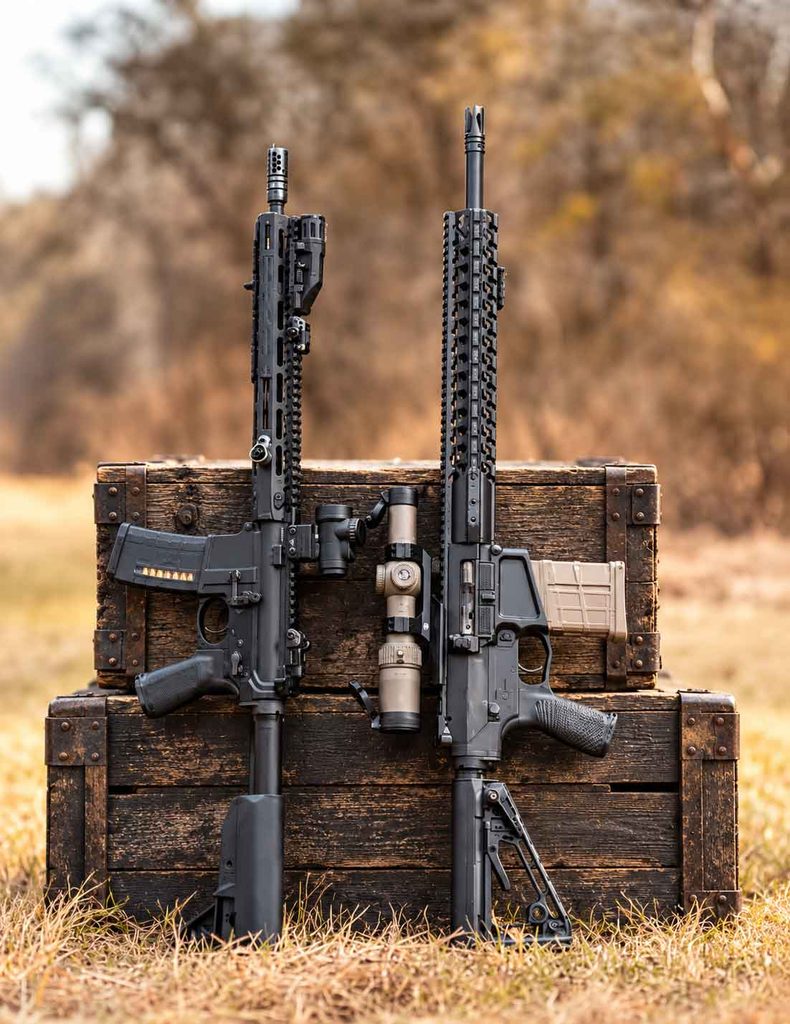
One of the most noticeable differences between an AR-10 and AR-15 is their overall size. While both rifles feature a similar layout, the larger platform was designed to accommodate full-power rifle cartridges such as .308 Winchester. Its smaller counterpart primarily uses intermediate cartridges, including 5.56 NATO and .223 Remington. These differences affect overall weight, recoil, ammunition capacity, and handling.
The AR-10 requires a larger receiver, magazine well, and operating components to accommodate its ammunition. As a result, many configurations weigh 7.5 to 10 pounds or more without ammunition. Standard AR-15 rifles generally weigh between 5.5 and 8 pounds, making them more convenient for extended carrying and recreational shooting. The added weight of a large-frame rifle can be especially noticeable during hunting trips or activities that require prolonged movement.
Weight matters most when you consider how you’ll use a rifle. Hunters traveling through uneven terrain may prefer a lighter firearm, while precision shooters firing from supported positions may prefer the stability a heavier platform offers. Neither approach is universally better, but the difference can substantially influence comfort, endurance, and the overall shooting experience.
AR-10 vs. AR-15 Comparison Chart
The following chart highlights the primary differences between these platforms, including their typical dimensions, ammunition options, recoil characteristics, and practical applications.
| Feature | AR-10 | AR-15 |
|---|---|---|
| Receiver size | Larger, designed for full-power rifle cartridges | Smaller, designed primarily for intermediate cartridges |
| Typical unloaded weight | 7.5–10+ lbs | 5.5–8 lbs |
| Common calibers | .308 Win, 6.5 Creedmoor, .243 Win | 5.56 NATO, .223 Rem, .300 BLK |
| Practical effective range | Often 600–1,000 yards | Often 300–600 yards |
| Felt recoil | Moderate to substantial | Generally mild with 5.56/.223 |
| Ammunition cost | Generally higher | Generally lower with 5.56/.223 |
| Magazine type | Commonly SR-25/DPMS pattern; varies by model | Standard pattern for 5.56/.223; varies by caliber |
| Best applications | Hunting, precision shooting, longer distances | Training, recreational shooting, home defense, competition |
These figures represent general characteristics, not guaranteed performance specifications. Barrel length, cartridge selection, ammunition quality, optics, and rifle configuration all affect practical shooting distances and overall weight. Some smaller-frame calibers can also deliver impressive long-range performance, while some lightweight large-frame configurations weigh considerably less than traditional precision rifles.
Understanding the Difference in Recoil
Recoil is another major consideration when comparing the AR-10 vs. AR-15. Because the larger platform commonly fires cartridges such as .308 Winchester, it generally produces more felt recoil than a rifle chambered in 5.56 NATO. Although its heavier construction helps absorb some of that force, shooters will typically notice a stronger rearward impulse.
The AR-15 produces relatively mild recoil in its standard chamberings, making it appealing to beginners and experienced shooters alike. Its manageable shooting characteristics allow for more comfortable extended practice sessions, particularly when firing numerous rounds at the range. Lower recoil can also help newer shooters build consistent fundamentals with less movement between shots.
An AR-10 can also be comfortable to shoot, especially when properly fitted to the shooter. However, additional recoil and weight may become more noticeable over time. Stock design, rifle weight, ammunition selection, and individual shooting technique all influence perceived recoil. Ultimately, the smaller platform offers a practical advantage for shooters prioritizing lightweight handling and comfort, while the larger platform provides access to cartridges with greater ballistic capabilities.
AR-10 Calibers vs. AR-15 Calibers
A major difference between these platforms is the ammunition each can accommodate. Both offer multiple caliber options, but their receiver dimensions determine the cartridge families they support. The AR-10 generally accommodates larger, full-power rifle cartridges, while the AR-15 uses smaller intermediate cartridges and certain specialty hunting rounds. These distinctions matter because caliber selection affects ammunition cost, recoil, hunting applications, and effective shooting distances.
Common AR-10 Calibers
AR-10 chambering options extend beyond .308 Winchester. Several cartridges have become popular among hunters and precision shooters because they offer different combinations of projectile weight, trajectory, and ballistic performance. While .308 Winchester remains the most recognizable option, other cartridges may be appropriate depending on the intended application.
.308 Winchester / 7.62×51 NATO: The .308 Winchester is one of the most widely recognized cartridges associated with large-frame rifles. Its widespread availability, established performance, and extensive ammunition selection make it popular for hunting, recreational shooting, and precision applications. Although .308 Winchester and 7.62×51 NATO are closely related, always follow the firearm manufacturer’s chamber specifications for ammunition compatibility.
6.5 Creedmoor: The 6.5 Creedmoor has become a popular alternative for shooters interested in longer-distance performance. Its aerodynamic projectiles generally retain velocity well and drift less in the wind than many comparable .308 Winchester loads. Shooters often choose it for precision shooting and hunting where consistent performance at extended distances matters.
.243 Winchester: The .243 Winchester offers relatively mild recoil for a full-power rifle cartridge and has an established history in varmint and deer hunting. Although less common in large-frame semiautomatic rifles than .308 Winchester, it remains available in certain compatible configurations.
6mm Creedmoor: The 6mm Creedmoor is commonly associated with precision rifle competition and longer-range target shooting. Its relatively high-velocity, aerodynamic projectiles can offer favorable trajectory characteristics, but frequent shooters should consider ammunition availability and barrel life.
.338 Federal: The .338 Federal uses larger-diameter projectiles and is primarily used for hunting. Less widely available than .308 Winchester, it offers hunters another option with different bullet characteristics in a compatible large-frame platform.
Not every AR-10 manufacturer offers all these chamberings. Receiver compatibility, magazine requirements, and ammunition specifications vary by model, making manufacturer documentation essential when evaluating less common calibers. Ammunition availability is another consideration, particularly for shooters who plan to practice regularly rather than reserve their rifles primarily for hunting.
Common AR-15 Calibers
The AR-15 supports a broad selection of ammunition, including 5.56 NATO, .223 Remington, .300 Blackout, 6.5 Grendel, 6mm ARC, .224 Valkyrie, .350 Legend, and .450 Bushmaster. These options provide different characteristics for recreational shooting, hunting, and precision applications. For a more detailed breakdown of cartridge selection and applications, explore our Best AR-15 Calibers guide.
Although larger-frame rifles generally accommodate more powerful cartridges, caliber alone does not determine the best platform. Some smaller-frame chamberings are intended for hunting or longer-distance use, while some large-frame configurations prioritize general-purpose use over dedicated precision shooting.
DPMS vs. Armalite Pattern AR-10s
Unlike the AR-15, which benefits from relatively widespread dimensional standardization, the AR-10 family lacks a single universal parts specification. Two major design families are commonly identified as the Armalite and DPMS LR-308 patterns. Differences in receiver geometry, component dimensions, and manufacturer-specific designs mean that parts advertised for one pattern may not fit another.
This distinction matters because even components from two rifles described as DPMS-compatible are not necessarily interchangeable. Before buying replacement components or starting a large-frame project, confirm the manufacturer’s specifications rather than assuming all parts share the same dimensions.
Which Parts Swap Between AR-10 and AR-15?
Despite their similar appearance, AR-10 and AR-15 rifles do not share universal parts compatibility. Both platforms use a modular design, but the larger rifle requires different components to accommodate longer cartridges and different receiver dimensions. Some accessories and selected small components are compatible across certain models, while major operating components, magazines, and receiver assemblies are generally platform-specific.
The following table provides a general overview of component compatibility between the two rifle families.
| Component | Compatibility | Important considerations |
|---|---|---|
| Pistol grips | Often interchangeable | Some receiver designs require specific grip styles or hardware |
| Trigger assemblies | Depends | Receiver dimensions, trigger specifications, and manufacturer approval matter |
| Adjustable stocks | Depends | Compatibility is determined by receiver extension and stock specifications |
| Receiver extensions | Depends | Some dimensions are shared, but complete buffer systems are not universally interchangeable |
| Safety selectors | Depends | Some designs share specifications; others require platform-specific components |
| Upper and lower receivers | Not interchangeable | Different receiver dimensions and cartridge requirements |
| Barrels | Not interchangeable | Platform and chamber specifications differ |
| Bolt carrier groups | Not interchangeable | Different dimensions and operating requirements |
| Magazines | Generally not interchangeable | Magazine dimensions and cartridge requirements differ |
| Charging handles | Generally not interchangeable | Larger-frame receivers typically require different dimensions |
| Handguards | Depends | Receiver dimensions and mounting specifications determine compatibility |
| Buffers and springs | Depends | Requirements vary by platform, receiver extension, and manufacturer |
The key takeaway is that a similar appearance does not guarantee interchangeability. Even when a component appears compatible, the manufacturer’s specifications determine whether it fits a particular rifle. This becomes especially important with large-frame designs because differences between DPMS-pattern, Armalite-pattern, and proprietary systems can create additional compatibility challenges.


Which Should You Buy or Build: AR-10 or AR-15?
Start by identifying how you’ll primarily use the rifle. Although both offer flexibility, differences in ammunition, weight, recoil, and overall cost make each better suited to certain applications. Whether you’re buying your first modern sporting rifle or considering a different configuration, understanding these priorities can help you invest more wisely.
Home Defense: AR-15
For home defense, the AR-15 is often favored because it is comparatively lightweight, produces manageable recoil, and is available in a variety of configurations. Many shooters also appreciate the widespread availability of 5.56 NATO ammunition and the platform’s familiar handling characteristics. Its lighter construction may appeal especially to people who find larger rifles hard to handle comfortably.
However, choosing a home defense firearm involves more than rifle dimensions. Safe storage, proper training, local regulations, and the potential for projectiles to penetrate interior walls all deserve consideration. Do not assume any centerfire rifle cartridge is safe from overpenetration in a residential environment. The AR-10 is generally heavier, produces more recoil, and is less commonly selected when compact handling and maneuverability are priorities.
Hunting Deer and Elk: AR-10
For hunters pursuing medium and large game, the AR-10 provides access to cartridges traditionally associated with larger hunting rifles. The .308 Winchester and 6.5 Creedmoor are established hunting cartridges, with suitable ammunition options available for various game animals. This makes the platform attractive for hunters who want a semiautomatic rifle chambered in a conventional full-power cartridge.
The AR-15 can also be appropriate for deer hunting in certain chamberings, including .350 Legend, 6.5 Grendel, and other cartridges that meet applicable hunting requirements. However, larger animals such as elk require greater attention to cartridge selection, appropriate ammunition, and the hunter’s ability to make an ethical shot. Hunting regulations vary by state and may restrict cartridges, magazine capacity, or firearm configurations. For someone primarily interested in larger game, a large-frame rifle offers a broader selection of conventional full-power hunting cartridges.
Long-Range Shooting: AR-10
Shooters interested in longer-distance target shooting frequently gravitate toward the AR-10 because of its available chamberings. Cartridges such as 6.5 Creedmoor and .308 Winchester have proven track records in precision shooting, and their ballistics make them suitable for extended distances. The added weight of many configurations may also provide greater stability from supported positions.
Nevertheless, don’t overlook the AR-15. Specialized cartridges such as 6mm ARC, 6.5 Grendel, and .224 Valkyrie show that smaller-frame rifles can perform well at considerable distances. A larger rifle does not automatically outperform a smaller one in accuracy, as barrel quality, ammunition consistency, environmental conditions, and shooter skill play major roles. For longer-range shooting with full-power cartridges, the larger platform remains a strong candidate, while certain smaller-frame configurations offer a lighter alternative.
Budget-Conscious Shooters: AR-15
The AR-15 typically offers a substantial cost advantage, especially for shooters who plan frequent range trips. Its popularity has created a large aftermarket, with numerous manufacturers producing compatible accessories and components at different price points. This availability gives buyers more options to compare features, quality, and overall cost.
Ammunition is another important expense. Standard .223 Remington and 5.56 NATO loads are generally less expensive than .308 Winchester or 6.5 Creedmoor ammunition, although prices fluctuate with availability and market demand. The difference becomes more noticeable over time, especially for shooters who regularly purchase several hundred rounds for recreational practice. Compared with the AR-10, the smaller platform generally offers a more affordable combination of purchase price, ammunition availability, and long-term ownership expenses.
First-Time AR Owners: AR-15
For someone purchasing their first AR-platform rifle, the AR-15 is generally the more approachable option. Its lighter weight, manageable recoil, and extensive educational resources make it easier to learn the platform’s basics. Its popularity also lets buyers compare a broad range of commercially available configurations before buying.
The platform benefits from more consistent component specifications across many manufacturers. Although compatibility should never be assumed, it generally presents fewer manufacturer-specific dimensional variations than the AR-10. Those interested in comparing available component packages can explore AR-15 build kits at Black Rifle Depot to learn more about the available options. Regardless of the platform selected, professional instruction in safe handling, storage, and maintenance is especially valuable for first-time owners. The best choice depends on intended use, budget, shooting experience, and how much you value portability versus cartridge performance. No matter which platform interests you, you need to understand caliber differences and component compatibility before you decide. Explore Black Rifle Depot for additional AR-platform information, component specifications, and educational resources to help you make an informed decision about your next rifle project.
Final Thoughts: AR-10 vs. AR-15 — Which Platform Is Right for You?
Understanding the differences between the AR-10 and AR-15 makes choosing between these popular rifle platforms considerably easier. While both offer modular designs and a wide range of configurations, differences in receiver size, ammunition, weight, recoil, and overall cost make each suit different priorities. The AR-15 remains an attractive option for recreational shooting, regular training, and shooters who appreciate lightweight handling and relatively affordable ammunition. Its widespread popularity has also produced a substantial aftermarket, providing numerous options for different preferences and applications.
The AR-10 offers the advantages of larger rifle cartridges, making it appealing for medium- and large-game hunting, precision applications, and longer-range shooting. Those benefits generally come with additional weight, stronger recoil, and higher ammunition expenses. Neither platform is universally superior, and the best choice ultimately depends on intended use, budget, shooting experience, and the importance placed on portability versus cartridge performance.
Whether you’re interested in the AR-15’s versatility or the AR-10’s larger-caliber capabilities, understanding component compatibility and performance differences is essential before you buy. Visit Black Rifle Depot to explore AR-platform components, compare available options, and find quality products for your next rifle project.
AR-10 vs. AR-15: Frequently Asked Questions
If you’re still weighing the differences between these two rifle platforms, the following answers cover some of the most common questions buyers and builders ask. From hunting use and accuracy to weight, cost, and caliber options, these quick answers can help clarify which platform best fits your needs.
Is an AR-10 Better Than an AR-15 for Hunting?
The AR-10 is often better suited for medium- and large-game hunting because it accommodates full-power rifle cartridges such as .308 Winchester and 6.5 Creedmoor. These cartridges are commonly used for deer and larger game. However, the AR-15 can also serve as an effective hunting platform when chambered in an appropriate cartridge. The best choice depends on the animal you’re hunting, your ammunition selection, the terrain, applicable hunting laws, and personal preference.
Is the AR-10 More Accurate Than the AR-15?
Not necessarily. Both platforms can provide excellent accuracy when equipped with quality components and paired with consistent ammunition. The AR-10’s available cartridges may offer advantages at extended distances, but that does not inherently make the rifle more mechanically accurate. Barrel quality, ammunition, optics, environmental conditions, and shooting fundamentals all influence results. A well-made AR-15 can outperform a poorly configured AR-10, particularly at distances where its cartridge performs effectively.
How Much Heavier Is an AR-10?
An AR-10 typically weighs about 1.5 to 3 pounds more than a similarly equipped AR-15, though the difference varies widely by model. AR-15 rifles typically weigh 5.5 to 8 pounds, while many AR-10 configurations weigh 7.5 to 10 pounds or more. Barrel profile, optics, handguards, and other accessories can significantly increase either rifle’s total weight.
Which is cheaper to shoot, an AR-10 or an AR-15?
The AR-15 is generally cheaper to shoot, especially when chambered in 5.56 NATO or .223 Remington. These cartridges are widely available and typically cost less per round than common AR-10 ammunition such as .308 Winchester or 6.5 Creedmoor. However, not every AR-15 caliber is inexpensive. Specialty cartridges can cost considerably more than standard 5.56 ammunition. Shooters comparing ownership expenses should consider their intended caliber and typical ammunition consumption.
What Is the Most Popular AR-10 Caliber?
The .308 Winchester is generally considered the most established and widely recognized AR-10 chambering. Its availability, versatility, and wide selection of commercial ammunition drive its popularity. Shooters use it for recreational shooting, precision applications, and hunting. The 6.5 Creedmoor is another prominent option, especially for shooters seeking longer-range ballistic performance. Availability varies by rifle manufacturer and market demand.
Can You Build an AR-10 From a Kit?
Yes, you can assemble an AR-10 from compatible components, and some manufacturers offer packaged component sets. However, unlike the AR-15, large-frame rifles don’t follow a single universal dimensional standard. Differences between DPMS, Armalite, and manufacturer-specific designs can affect component compatibility. Not every package includes every component required for a complete firearm, and receiver-related requirements vary. Before use, evaluate any project for manufacturer compatibility, legal compliance, and an appropriate professional inspection.
For additional support and online deals, check out our X Page.
