
AR-15 Pistol
How to Build an AR-15 Pistol: Parts, Brace & Barrel Guide
Oct
Table of Contents
An AR pistol build offers a compact alternative to a traditional AR-15 rifle, but you need to understand the differences between pistol and rifle configurations before you start. Unlike a conventional rifle, an AR-15 pistol is classified by its design and intended use, not just its barrel length or appearance. For buyers comparing available configurations, a pistol-specific component package can simplify product research by grouping compatible parts. This guide covers the major component categories, buffer systems, stabilizing braces, barrel lengths, and important legal considerations for 2026, helping you understand what separates an AR pistol from other AR-platform firearms. This article is for general informational purposes only and does not constitute legal advice. Firearm laws vary by jurisdiction and can change, so consult a qualified attorney before making decisions.
AR-15 Pistol Parts List: Understanding the Components
Before considering an AR pistol build, it helps to understand the major component groups used in AR-platform firearms and how they differ from traditional rifle configurations. Although both platforms share many design characteristics, a completed firearm’s classification depends on more than the components’ individual descriptions. Receiver history, overall configuration, intended use, and applicable laws also matter.
One advantage of the AR platform is the wide availability of manufacturer-specific components and accessories. However, interchangeable appearance does not guarantee compatibility. Differences in receiver specifications, barrel configurations, recoil systems, and manufacturer requirements can affect how components work together. This matters most when comparing complete component packages with individually purchased parts.
AR Pistol Component Overview
The following table provides a general reference to the major component categories. It is intended for product identification and comparison, not as an assembly checklist.
| Component Category | What to Look For | Rifle vs. Pistol Difference |
|---|---|---|
| Lower receiver and controls | Manufacturer specifications, identification, and configuration history | Receiver history and completed configuration can affect legal classification |
| Receiver extension and buffer system | Manufacturer-approved system compatibility | Rear configurations vary; stock and brace distinctions matter |
| Stabilizing brace or bare extension | Intended function, fitment information, and current legal status | A stabilizing brace is not automatically classified as a rifle stock |
| Upper receiver assembly | Manufacturer compatibility and complete assembly specifications | Upper receivers can share designs, but configurations differ |
| Barrel assembly | Chambering, barrel length, manufacturer specifications | Shorter barrels introduce additional performance and legal considerations |
| Gas-system components | Manufacturer-approved configuration | Requirements vary with the complete firearm design |
| Bolt carrier group and charging handle | Compatibility with the manufacturer’s platform | Similar product designs do not guarantee universal compatibility |
| Handguard and muzzle accessories | Fitment information, dimensions, and intended use | Available configurations vary by barrel and manufacturer |
These categories help buyers distinguish between complete packages, replacement components, and accessories. Also review product descriptions carefully, as included parts vary by manufacturer and model. Some packages contain assembled components, while others provide only selected parts and exclude the serialized receiver.
For a broader overview of available packages and configurations, explore Black Rifle Depot’s AR-15 build kits collection. Comparing documented specifications is a useful starting point, especially for buyers who want to know which components are included before deciding to buy.


Pistol Buffer Tube, Buffer, and Spring: What Makes Them Different?
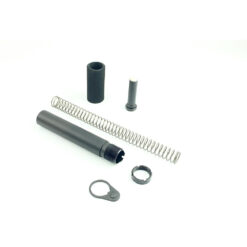
The buffer system is an important part of many conventional AR-pattern firearms because it controls the movement of operating components during cycling. This system generally involves a receiver extension, recoil buffer, and action spring. Although these components are found in both rifle and pistol configurations, their dimensions and compatibility requirements can vary considerably.
A pistol buffer tube is commonly associated with rear configurations that do not use a traditional rifle shoulder stock. Some dedicated pistol extensions feature a smooth exterior without the adjustment notches associated with adjustable rifle stocks. However, not every brace-compatible receiver extension uses this design. Some stabilizing braces are made specifically for compatible adjustable carbine-style extensions, so they don’t require a smooth tube.
The buffer and spring are separate components within the operating system. Their characteristics affect how the mechanism responds during cycling, but no universal buffer specification fits every compact configuration. Cartridge selection, manufacturer design, and the complete operating system all affect compatibility. Selecting parts based solely on barrel length, or assuming a heavier buffer is always better, can lead to incorrect component matching.
Shorter firearms sometimes cycle differently than their longer counterparts, so manufacturer-approved specifications matter. Rather than treating individual buffer weights as interchangeable solutions, owners should rely on documentation for the exact firearm or complete assembly and seek qualified gunsmith evaluation when compatibility is uncertain.
Black Rifle Depot carries receiver extensions and recoil-system components through its stock and buffer kits collection. Review component descriptions and fitment information to clarify differences between available product families.
Pistol Brace or Bare Tube: Understanding the Options
One of the most recognizable features of many AR-style pistols is the absence of a conventional rifle shoulder stock. Instead, these firearms may have a bare receiver extension or a stabilizing brace, depending on their configuration and intended design. Understanding the distinction matters because appearance alone does not determine a firearm’s legal classification.
A stabilizing brace is an accessory originally developed to provide forearm support when handling certain firearms. Brace designs vary in materials, attachment interfaces, and adjustment mechanisms. By comparison, a bare receiver extension lacks this forearm-support accessory. Some firearm platforms also use alternative rear-interface designs rather than a conventional AR-style buffer tube.
Comfort and compatibility vary substantially among accessories. Do not assume a product designed for one rear-interface system is compatible with another, even when both are marketed for pistol configurations. Manufacturer documentation remains the most reliable reference for the accessory’s intended application and dimensions.
Pistol Brace Legal Status in 2026
Legal review required — Last updated October 21, 2026
A federal court vacated the federal government’s 2023 stabilizing-brace rule, and ATF proposed removing the disputed regulatory provisions in May 2026. However, ATF has explained that whether a particular firearm qualifies as a rifle remains a fact-specific question under federal statutory definitions. A product described as a brace does not automatically determine the legal classification of the complete firearm.
State and local restrictions may impose additional requirements, and the October 2026 federal enforcement changes discussed later in this article should not be confused with a blanket exemption from all firearm regulations. Buyers should verify current rules before changing a firearm’s configuration.
For additional background on brace designs, readers can review educational materials covering different stabilizing accessories and their intended applications. Black Rifle Depot also offers a selection of pistol braces and related accessories for customers comparing commercially available options.
Barrel Length and Gas System: What Are the Differences?
Barrel length is one of the most important characteristics to understand when comparing compact AR-platform firearms. It influences overall dimensions, weight distribution, muzzle blast, and ammunition performance. Shorter barrels generally make a firearm more compact, but they also tend to produce lower muzzle velocities than longer barrels firing the same ammunition. The extent of that difference depends on cartridge design, ammunition characteristics, and individual barrel specifications.
The best AR pistol barrel length is not necessarily the shortest available. Buyers should consider their preferred cartridge, intended recreational application, noise exposure, and the manufacturer’s specifications before evaluating different configurations. A compact firearm may be easier to transport and store, but a shorter overall length doesn’t eliminate the trade-offs associated with muzzle blast and ammunition performance.
AR Pistol Barrel Length Comparison
The following chart provides an overview of common barrel lengths found in commercially available AR-style pistol configurations.
| Barrel Length | General Characteristics | Noise and Muzzle Blast | Velocity Considerations |
|---|---|---|---|
| 7.5 inches | Very compact configuration | Often especially pronounced | Greater velocity reduction, particularly with 5.56 NATO |
| 8.5 inches | Compact, with slightly more barrel length | Typically substantial | Performance varies significantly by cartridge |
| 10.3–10.5 inches | Common short-barrel category | Generally greater blast than longer barrels | More velocity potential than very short barrels |
| 11.5 inches | Intermediate compact configuration | Still substantial, depending on ammunition | Generally offers additional velocity over shorter alternatives |
| 12.5 inches | Longer compact configuration | Often less severe than very short setups | Can preserve more velocity while remaining shorter than conventional rifles |
The table illustrates general trade-offs, not guaranteed performance. Two firearms with identical barrel lengths may produce different results because of ammunition, chamber specifications, barrel construction, and other variables. Gas-system dimensions also vary by manufacturer, and barrel length alone doesn’t determine the correct operating-system configuration.
How Barrel Length Affects Performance
Short barrels are often associated with compact firearms because they reduce overall length and can lower weight. However, a shorter barrel gives expanding propellant gases less distance to accelerate the projectile before it exits the muzzle. This generally reduces velocity compared with a longer barrel of the same chambering, though the reduction varies significantly by cartridge.
Noise and muzzle blast are equally important considerations. Short-barreled centerfire firearms can produce substantial sound pressure and concussion, making appropriate hearing protection especially important. Muzzle devices may also change how the blast is perceived by the shooter and nearby individuals, but they do not eliminate the need for proper hearing protection.
Ammunition characteristics influence these differences. For example, 5.56 NATO and .300 Blackout have different ballistic characteristics, so identical barrel lengths should not be assumed to produce comparable results. Buyers comparing compact configurations should consider the complete firearm and its intended cartridge rather than focusing exclusively on barrel dimensions.
Understanding Pistol-Length and Carbine-Length Gas Systems
Many AR-pattern firearms use gas-operated mechanisms, and manufacturers offer different gas-system dimensions to suit their designs. Terms such as pistol-length and carbine-length refer to standardized categories of gas-tube and associated component dimensions. These descriptions are not interchangeable with firearm classifications; a carbine-length gas system does not automatically make a firearm a rifle.
Gas-system design closely relates to the firearm’s overall operating characteristics, including its barrel and cartridge specifications. No universal rule makes one gas-system length appropriate for every firearm with a particular barrel length. For that reason, manufacturer-approved complete configurations provide a more reliable reference than assumptions based on appearance or overall dimensions.
Buyers researching shorter firearms should compare documented factory specifications, verify compatibility claims, and consult a qualified gunsmith when questions arise. This matters because an incorrectly matched operating system can affect reliability and safe function.
AR Pistol Build Steps at a Glance: Planning and Safety
Building an AR pistol starts with recognizing that component selection, firearm classification, and mechanical safety are separate considerations. This overview covers planning and verification, not mechanical assembly instructions.
- Confirm the legal classification. Review applicable federal, state, and local regulations, including restrictions on firearm configuration, receiver history, and possession.
- Identify the intended configuration. Compare complete manufacturer specifications, available chamberings, and documented features before purchasing components.
- Review component compatibility. Carefully review product documentation, especially when comparing parts from different manufacturers or product families.
- Understand the included components. Determine whether a commercial package contains a complete assembly or only selected parts, and verify any exclusions directly with the retailer.
- Arrange professional inspection. Have a qualified gunsmith evaluate component compatibility, assembly integrity, and essential safety functions before using a newly assembled firearm.
- Follow safe handling and maintenance practices. Use manufacturer-approved ammunition, understand the firearm’s operating instructions, and obtain appropriate training before recreational shooting.
One of the most common purchasing mistakes is assuming similarly named component packages are identical. Manufacturers may offer comparable configurations with different accessories, receiver requirements, or included hardware. Reviewing the complete product description can help avoid confusion and unnecessary expenses.
The same principle applies when comparing a factory-assembled firearm with a component package. A commercially manufactured firearm may offer factory quality control and manufacturer support, while individually sourced components require more attention to compatibility and professional verification.
AR Pistol vs. SBR in 2026: Understanding the Legal Differences
Legal review required — Last updated October 21, 2026
The AR pistol vs. SBR discussion has changed significantly in 2026, making it particularly important to distinguish firearm classification from federal tax and enforcement requirements. Although both configurations may have relatively short barrels, their legal classifications depend on applicable statutory definitions and the firearm’s overall characteristics.
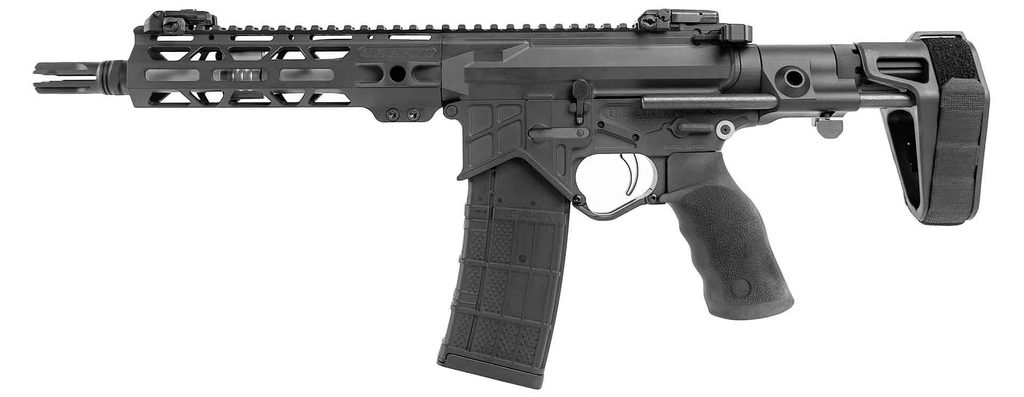
An AR-style pistol is generally designed and intended to be fired as a handgun, while a short-barreled rifle, commonly called an SBR, fits the statutory definition of a rifle and meets certain barrel-length or overall-length criteria. A particular accessory does not automatically settle this distinction.
What Changed on January 1, 2026?
Beginning January 1, 2026, federal making and transfer taxes were reduced to $0 for certain National Firearms Act items, including short-barreled rifles, short-barreled shotguns, suppressors, and firearms classified as any other weapons. This eliminated the previously applicable $200 federal making or transfer tax for those categories. The change did not, by itself, repeal the National Firearms Act or eliminate every associated legal requirement.
The tax reduction was significant for individuals interested in NFA-regulated firearms, but taxes are only one component of firearm regulation. State restrictions, federal prohibitions, interstate transportation rules, and classification standards must still be considered.
What Changed on October 9, 2026?
On October 9, 2026, ATF announced that it would not enforce certain NFA application, approval, registration, and related requirements for covered categories of firearms and devices. The decision followed federal litigation and reflected the Department of Justice’s enforcement policy, not a congressional repeal of the underlying statutory provisions.
The distinction is important because an enforcement policy can change. Future legal developments or changes in federal policy could restore enforcement, and individuals should not assume unregistered items will automatically be grandfathered if circumstances change.
The October guidance also does not override applicable state or local firearm laws. Individuals transporting SBRs interstate remain subject to the federal Gun Control Act’s prior-approval requirement, generally addressed through ATF Form 20, even under the current non-enforcement policy.
Why State Laws Still Matter
Federal policy is only part of the legal framework. Individual states may prohibit certain firearm configurations, impose additional restrictions, or require compliance with specific registration provisions. As a result, a firearm subject to reduced federal enforcement is not automatically lawful to possess, transfer, or transport in every state.
This makes legal research especially important for anyone considering a compact AR-platform firearm. A retailer’s product description, a manufacturer’s designation, or a federal enforcement announcement should not replace a review of applicable state law.
Because federal guidance changed in October 2026, legal counsel should review this section before publication and revisit it whenever the ATF or courts issue significant new guidance.
Final Thoughts: Understanding Your AR Pistol Options
An AR pistol build involves more considerations than choosing a compact barrel or a particular rear accessory. Before evaluating options, understand how receiver configurations, buffer systems, operating components, barrel dimensions, and legal classifications differ. Although AR-platform firearms share many common design features, individual manufacturers may use different specifications that affect component compatibility and overall performance.
Barrel length matters because it affects the firearm’s dimensions, muzzle blast, and ammunition performance. Recoil-system specifications and manufacturer compatibility requirements also deserve attention, particularly when comparing commercial configurations from different brands. Legal distinctions between pistols and short-barreled rifles are also important and have been affected by significant federal developments in 2026.
When buyers compare available configurations, reviewing complete product specifications and seeking professional guidance can reduce uncertainty. A well-documented product selection process is more valuable than assuming compatibility or relying on outdated regulatory information.
Explore Black Rifle Depot for AR-platform product information, accessories, and educational resources. Browse the available AR-15 build kits to compare advertised configurations, review component specifications, and find quality products that meet your needs. Whether you’re researching your first compact AR-platform firearm or exploring component options, Black Rifle Depot offers products and resources to help you make an informed purchasing decision.
Frequently Asked Questions About AR Pistol Builds
If you’re considering an AR pistol build, understanding the differences between component categories, barrel configurations, and legal classifications can help answer several common questions. The following FAQs address the topics buyers frequently research when comparing compact AR-platform firearms, including recoil-system terminology, barrel length, stabilizing braces, and federal regulations.
What Parts Do I Need to Build an AR-15 Pistol?
An AR-15 pistol uses several major component groups found in conventional AR-pattern firearms, including receiver assemblies, operating components, a barrel assembly, and an appropriate recoil system. However, component requirements differ by manufacturer, chambering, and configuration. Commercial packages may contain different combinations of assembled components and accessories, and not every package includes the serialized receiver. A complete manufacturer’s specification sheet and professional compatibility review are more reliable than assuming that every AR-platform component is interchangeable.
What’s the Difference Between a Pistol Buffer Tube and a Carbine Buffer Tube?
A dedicated pistol buffer tube is commonly designed for rear configurations without a traditional adjustable rifle stock. Some have smooth exterior surfaces, while conventional adjustable carbine receiver extensions often feature positioning notches. However, some stabilizing braces fit compatible carbine-style extensions, so adjustment notches alone don’t determine the firearm’s classification. Receiver extension dimensions, intended applications, and manufacturer specifications determine compatibility.
What’s the Best Barrel Length for an AR Pistol?
No single AR pistol barrel length is best because performance depends on the intended cartridge, firearm design, and shooting application. Shorter barrels generally reduce overall dimensions but can increase muzzle blast and reduce projectile velocity compared with longer barrels. Common commercial configurations range from about 7.5 to 12.5 inches, though other lengths are available. Buyers should compare verified specifications rather than assuming the shortest configuration automatically provides the best performance.
Which Gas System Should a 10.5-Inch AR Pistol Use?
A 10.5-inch barrel does not automatically determine the appropriate gas-system configuration. Manufacturers may use different operating-system specifications depending on the firearm’s chambering and overall design. The safest reference is the manufacturer’s documented configuration, not a universal recommendation based solely on barrel length. If you’re unsure about an existing firearm’s gas system or component compatibility, consult the manufacturer or a qualified gunsmith.
Can I Put a Vertical Foregrip on an AR Pistol?
(Legal review required)
Adding a vertical foregrip can affect a firearm’s legal classification. ATF has historically treated certain handguns equipped with vertical foregrips as firearms classified under the NFA as any other weapons. Although the October 2026 guidance changed federal enforcement for that category, it did not automatically remove all classification, state-law, or firearm-configuration considerations. Owners should seek a current legal determination before modifying a firearm.
Is an AR Pistol or an SBR Better Now That the Tax Stamp Is $0?
(Legal review required)
Eliminating the federal making and transfer tax changes the cost comparison, but it does not make the two classifications interchangeable. The October 2026 ATF non-enforcement policy also introduces legal considerations that may change if the government revises its position. State firearm restrictions, travel requirements, intended use, and ownership circumstances all remain relevant. No universal advantage applies to every owner, especially when state laws impose separate restrictions on short-barreled rifles.
Can I Turn My AR-15 Rifle Into a Pistol?
(Legal review required)
A firearm’s original configuration can significantly affect its legal classification. Under longstanding ATF interpretations, a firearm originally manufactured or assembled only as a rifle is not necessarily eligible for reclassification as an ordinary pistol simply by changing its physical configuration. ATF Ruling 2011-4 distinguishes certain firearms originally configured as pistols from firearms originally assembled as rifles. The October 2026 enforcement policy does not eliminate the importance of those distinctions or applicable state laws.
For additional resources and online deals, check out our X Page.
