
AR-15 Handguards
Best AR-15 Handguard Types: 5 Things to Look For in 2026
Jul
Table of Contents
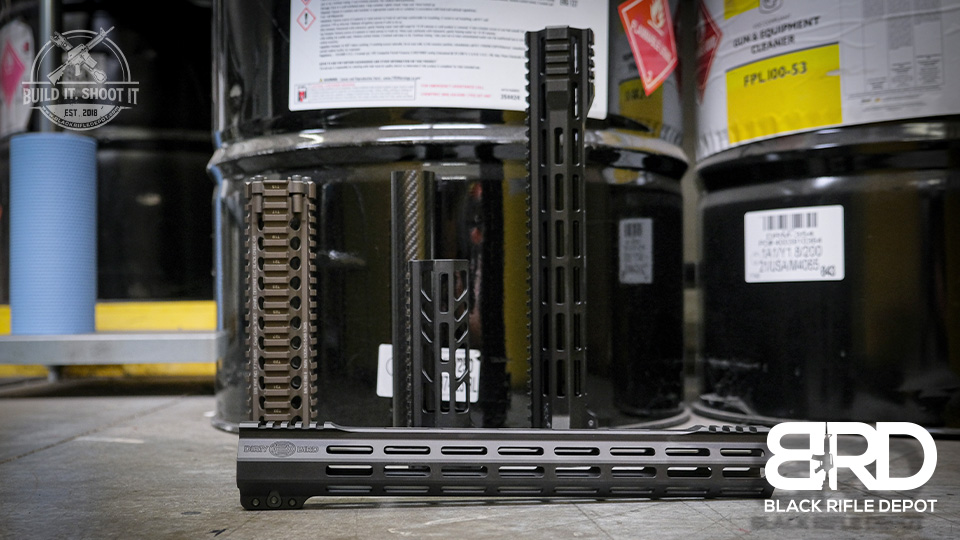
Choosing the right AR-15 handguard is one of the most important decisions you can make when building or upgrading a rifle. It affects how the rifle feels in your hands, how much weight sits out front, what accessories you can mount, how the barrel performs, and how easy the rifle is to control during regular use.
For many builders, the handguard is treated like a simple cosmetic upgrade. That is a mistake. The right AR-15 handguard can make a rifle feel lighter, more stable, more useful, and better suited for your intended setup. The wrong one can make the rifle front-heavy, uncomfortable, limited in use, or harder to configure later.
In 2026, most AR-15 handguards fall into a few main categories: free-float handguards, drop-in handguards, M-LOK handguards, quad rails, and KeyMod handguards. Each type has strengths, trade-offs, and a specific kind of builder it makes sense for. Before choosing based only on looks, it helps to understand what each design actually does and what features matter most.
Why the AR-15 Handguard Matters
The handguard gives your support hand a place to grip the rifle while protecting your hand from barrel heat. It also provides mounting space for lights, sling mounts, hand stops, rail covers, bipods, front sights, and other accessories. Depending on the design, it may also help improve practical accuracy by keeping pressure off the barrel.
A quality AR-15 handguard should match your barrel length, gas system, accessory needs, and shooting style. A short defensive rifle may need a compact, lightweight rail with room for a light and sling mount. A precision-focused rifle may benefit from a longer free-float handguard that supports a stable shooting position. A budget range rifle may only need a simple drop-in setup.
There is no single best option for every build. The best AR-15 handguards are the ones that fit the rifle’s purpose.
Free-Float AR-15 Handguards
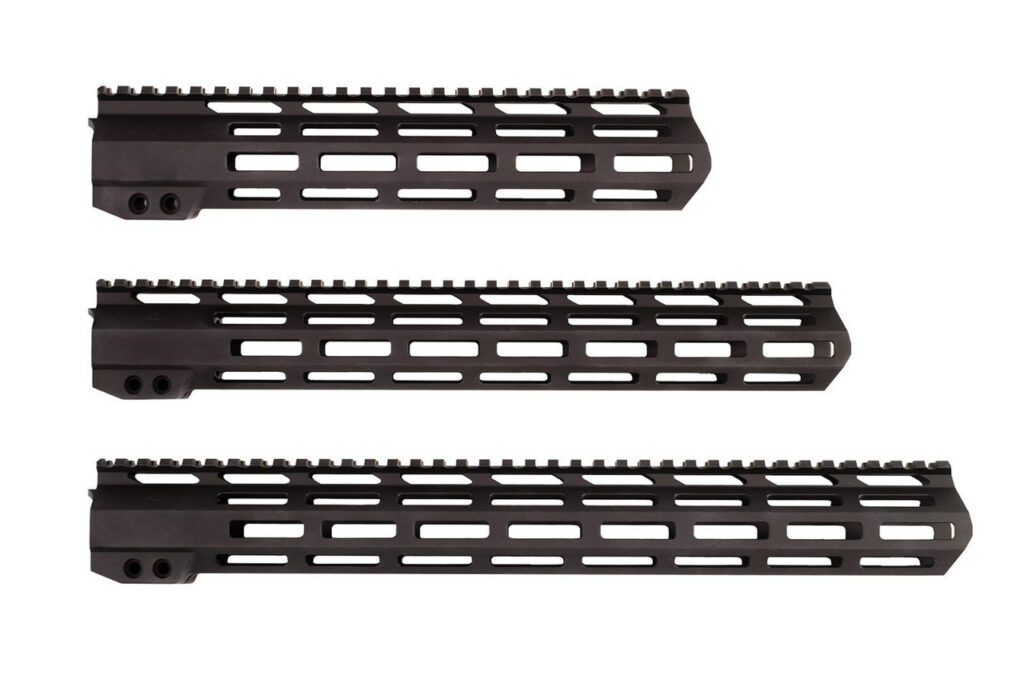
A free-float handguard attaches to the upper receiver area using its own barrel nut system and does not contact the barrel along its length. This design helps reduce outside pressure on the barrel from the shooter’s support hand, a sling, a barricade, or a bipod.
Free-float handguards are popular because they offer better accessory placement, longer rail options, improved rigidity, and a cleaner modern appearance. They are commonly found on performance builds, defensive rifles, competition setups, and precision-oriented AR-15s.
The main advantage is consistency. When the handguard does not press against the barrel, the barrel can vibrate more consistently from shot to shot. That does not automatically turn every rifle into a precision gun, but it can help reduce point-of-impact shifts caused by pressure on the forend.
The trade-off is installation. Many free-float handguards require removing the old handguard, delta ring assembly, and sometimes the front sight base. They may require a compatible barrel nut, a torque wrench, an armorer’s wrench, a vise block, and proper alignment. For a new build, that is usually not a problem. A simple upgrade may be more involved than a drop-in handguard.
Free-float is usually the best choice if you want maximum flexibility, modern accessory mounting, and better performance potential.
Drop-In AR-15 Handguards
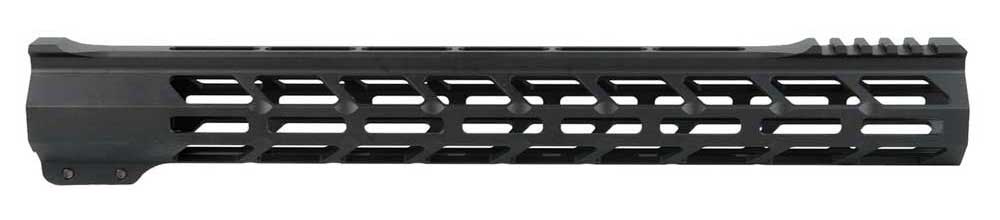
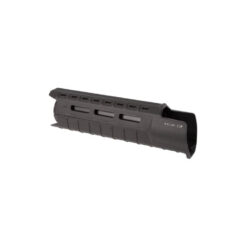
Drop-in handguards are the traditional style found on many standard AR-15 rifles. They are held in place by the delta ring assembly at the rear and the handguard cap near the front sight base. They are simple, affordable, and easy to install without major tools.
The biggest advantage of a drop-in handguard is convenience. If you have a standard carbine-length, mid-length, or rifle-length gas system with the correct front sight base and handguard cap, a drop-in replacement can be quick and straightforward.
Drop-in AR-15 handguards are a good option for basic range rifles, budget builds, and owners who want to keep a more classic look. They are also useful when the shooter does not need a long rail, does not plan to mount many accessories, and does not want to disassemble the upper receiver.
The downside is that drop-in handguards generally do not offer the same level of rigidity or barrel isolation as a free-float rail. Since they interact with the front handguard cap area, pressure on the handguard can transfer more influence to the barrel assembly. For casual shooting, that may not matter much. For precision work, it can.
Drop-in handguards still have a place in 2026. They are not outdated for every build. They are simply more limited than modern free-float designs.
M-LOK Handguards
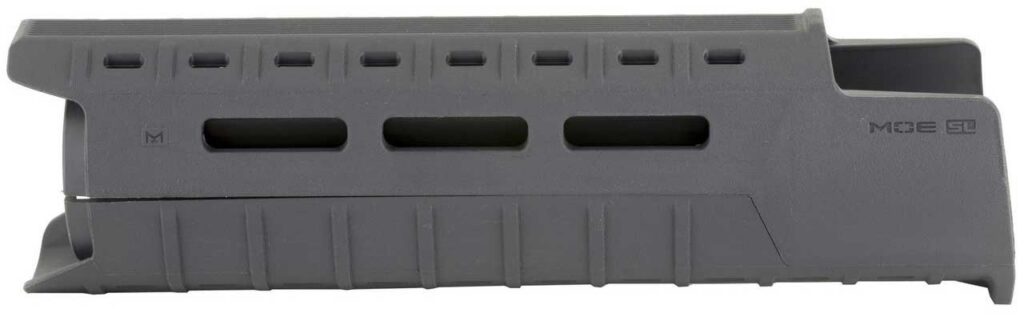
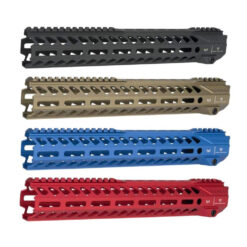
M-LOK has become one of the most popular attachment systems for modern AR-15 handguards. Instead of full-length rail sections on every side, M-LOK uses slots that allow accessories to mount only where needed. This helps keep the handguard slimmer, lighter, and more comfortable.
For most builders in 2026, an M-LOK AR-15 handguard is the default recommendation. It gives you strong accessory support without the bulk of a quad rail. You can mount a weapon light, sling attachment, hand stop, vertical grip, angled grip, bipod adapter, rail covers, or short Picatinny rail section exactly where you want it.
M-LOK handguards are also comfortable to grip because they usually have a smoother profile than older rail systems. Less unused rail space means fewer sharp edges and less need for bulky covers. That makes them a strong choice for home defense rifles, training rifles, lightweight builds, and general-purpose ARs.
Another benefit is variety. M-LOK handguards are available in many lengths, profiles, materials, colors, and price ranges. Whether you want a short rail for a compact AR pistol build or a long slim rail for a 16-inch or 18-inch rifle, M-LOK options are easy to find.
If you are not sure which handguard type to choose, M-LOK is usually the safest modern option to start with.

Quad Rail Handguards
Quad rails use Picatinny rail sections on all four sides of the handguard. For years, this was the standard for mounting serious accessories. They are strong, proven, and still preferred by some shooters who want maximum rail space and a rugged feel.
The biggest advantage of a quad rail is direct compatibility with Picatinny accessories. Lights, grips, bipods, rail covers, lasers, sling mounts, and other attachments can mount without additional adapter sections. For duty-style builds, clone rifles, and hard-use setups, quad rails still make sense.
Quad rails also have a specific feel. Some shooters like the squared-off shape and the secure grip that rail covers or panels provide. Others find them bulky compared to modern M-LOK handguards.
The main downsides are weight and comfort. A full quad rail typically has more material than a slim M-LOK handguard. Unused rail space can add bulk, and the edges may require covers to make the handguard more comfortable during extended use.
A quad rail is still a strong choice if durability and accessory compatibility matter more than keeping the rifle as light and slim as possible. It may not be the trendiest option in 2026, but it remains one of the most proven AR-15 handguard types.

KeyMod Handguards
KeyMod was once a major competitor to M-LOK. It uses keyhole-shaped slots that allow compatible accessories to attach directly to the handguard. Like M-LOK, it was designed to reduce unnecessary rail weight and allow accessories to mount only where needed.
KeyMod handguards can still work well, especially if you already own KeyMod accessories or find a quality rail at a good price. Many shooters used them successfully for years. They are often slim, lightweight, and comfortable.
However, M-LOK has become the more dominant modern standard. That means there are generally more M-LOK accessories, more handguard options, and broader long-term support. For a new build in 2026, most buyers are better served by M-LOK unless they have a specific reason to choose KeyMod.
KeyMod is not useless. It is just less common than it used to be.

The Top 5 Things to Look For in an AR-15 Handguard
1. Free-Float vs. Drop-In Design
The first decision is whether you want a free-float or drop-in handguard. This choice affects installation, accuracy potential, accessory mounting, and cost.
Choose a free-float handguard if you are building from scratch, upgrading for performance, adding multiple accessories, or trying to improve consistency. Choose a drop-in handguard for a simple, affordable upgrade to a standard rifle without major installation work.
For most modern AR-15 builds, free-float is the better long-term choice. For simple budget rifles, drop-in still makes sense.
2. Mounting System
The next thing to consider is the attachment system. M-LOK, Picatinny quad rail, and KeyMod are the most common.
M-LOK is the best all-around choice for most modern builds because it offers strong accessory support without excess weight. Quad rails are best for shooters who want full Picatinny compatibility and a more rugged, traditional rail setup. KeyMod is best for someone who already owns KeyMod accessories or finds a specific rail that fits their needs.
Do not choose a mounting system based only on appearance. Think about the accessories you actually plan to use.
3. Handguard Length
Handguard length affects grip placement, accessory space, sight radius, weight, and appearance. A longer handguard gives you more room for your support hand, light placement, sling mount position, and accessories. It can also provide a more modern look by covering more of the barrel.
However, longer is not always better. Extra length can add weight, especially on the front of the rifle. A short barrel with a long handguard also requires careful attention to muzzle device clearance.
A 7-inch handguard may work for compact builds. A 9-inch to 10-inch handguard is common for shorter setups. A 12-inch to 15-inch handguard is popular on many 16-inch rifles. Longer precision rifles may use extended handguards for bipods and stable shooting positions.
Match the handguard length to the barrel, gas system, and intended use.
4. Weight and Profile
Weight matters more than many builders expect. A few ounces at the front of the rifle can change how it feels during movement, transitions, and long-range sessions.
Slim M-LOK handguards are popular because they reduce bulk and keep the rifle easy to handle. Heavy quad rails may feel more durable, but they can make the rifle front-heavy. Lightweight handguards are great for fast handling, but extremely light rails may not feel as rigid under hard use.
The profile also affects comfort. Some handguards are round and slim. Others are wider, flatter, or more squared off. If you use a thumb-over-bore grip or extended support-hand position, shape matters.
A good handguard should feel natural, not just look good in product photos.
5. Build Quality and Installation Hardware
A handguard is only as good as its mounting system. Look for solid construction, a reliable barrel nut design, anti-rotation features, clean machining, and a durable finish. Poor mounting hardware can lead to alignment problems, shifting, or frustration during installation.
A quality AR-15 handguard should lock up securely and stay aligned with the upper receiver. This matters if you plan to mount backup sights, lights, lasers, or pressure switches. Even if you are not building a duty rifle, you still want a rail that feels solid.
Also consider whether the handguard includes the barrel nut, mounting screws, wrench, or shims. Some rails include everything needed, while others may require additional tools or parts.
Best Handguard Type for Different Builds
For a general-purpose AR-15, a free-float M-LOK handguard is usually the best choice. It offers a clean balance of weight, comfort, accessory support, and modern compatibility.
For a budget rifle, a drop-in handguard may be the easiest and most affordable option. It can improve grip and accessory mounting without requiring a full upper receiver teardown.
For a rugged duty-style build, a quad rail may still be the best fit. It is durable, proven, and compatible with Picatinny accessories without extra adapters.
For a lightweight build, choose a slim M-LOK handguard with as few unnecessary rail sections as possible. Keep the accessory loadout simple and avoid adding more weight than you need.
For a precision or SPR-style build, a longer free-float handguard makes sense. It gives you more room for support-hand placement, bipod mounting, and stable shooting positions.
Common AR-15 Handguard Mistakes
One of the biggest mistakes builders make is choosing a handguard based only on length or looks. A handguard that looks great may not fit your gas block, barrel, muzzle device, or accessory setup.
Another mistake is ignoring the inside diameter. This matters if you are using a larger gas block or planning to tuck a muzzle device under the rail. Not every handguard has enough internal clearance.
Builders also sometimes buy too much rail. A long, heavy handguard with accessories on every side may look impressive, but it can make the rifle slower and less comfortable. The best setup is usually the one that gives you the mounting space you need without unnecessary weight.
Finally, some builders overlook installation. Free-float rails can be excellent, but only when properly installed. If the barrel nut is not torqued correctly, the rail is not aligned, or the mounting hardware is not secured properly, performance and reliability can suffer.



Conclusion: Choose the Handguard That Fits the Rifle
The best AR-15 handguard is not always the most expensive, longest, or most aggressive-looking option. It is the one that matches your rifle’s purpose.
For most modern builds, a free-float M-LOK handguard is the best starting point. It gives you excellent accessory flexibility, a slimmer grip, lower weight, and strong performance potential. For classic builds or simple upgrades, drop-in handguards still work. For rugged accessory-heavy rifles, quad rails remain a proven choice.
Before you buy, think about how the rifle will actually be used. Consider length, mounting system, weight, installation, accessory needs, and overall balance. A well-chosen handguard can completely change how your rifle handles.
Ready to upgrade your rifle? Shop AR-15 Handguards and Rails for Sale at Black Rifle Depot and find M-LOK handguards, quad rails, free-float rails, and other top-quality options for your next AR-15 build.
FAQ’s About AR-15 Handguards
Choosing an AR-15 handguard gets easier once you understand how each type affects weight, installation, accessory mounting, and overall rifle performance. These common questions can help narrow down the best option for your build.
What is the best AR-15 handguard type in 2026?
For most builders, a free-float M-LOK handguard is the best all-around choice in 2026. It offers a strong balance of weight savings, accessory support, comfort, and modern compatibility.
Is a free-float handguard better than a drop-in handguard?
A free-float handguard is usually better for performance, accessory placement, and accuracy potential. A drop-in handguard is better for simple, affordable upgrades on standard rifles.
Are quad rails still worth buying?
Yes, quad rails are still worth buying if you want rugged construction and direct Picatinny accessory compatibility. They are heavier than many M-LOK handguards, but they remain strong and proven.
Is M-LOK better than KeyMod?
For most new builds, M-LOK is the better choice because it has wider accessory support and stronger market availability. KeyMod can still work if you already own compatible accessories.
What length AR-15 handguard should I choose?
Choose a length based on barrel length, gas system, accessory placement, and how far forward you like to grip the rifle. Many 16-inch rifles use handguards in the 12-inch to 15-inch range.
Can I install an AR-15 handguard myself?
Some drop-in handguards are very easy to install. Free-float handguards may require more tools, proper barrel nut installation, and careful alignment.
Does an AR-15 handguard affect accuracy?
It can. A free-float handguard can help reduce pressure on the barrel, potentially improving consistency compared to some drop-in designs.
What is the lightest AR-15 handguard type?
Slim M-LOK handguards are usually among the lightest common options. Exact weight depends on length, material, mounting hardware, and design.
Should I choose aluminum or polymer?
Aluminum is preferred for most free-float rails because it offers strength, rigidity, and heat resistance. Polymer can work well for basic drop-in handguards and budget-friendly setups.
Do I need rail covers on my handguard?
Rail covers are helpful for comfort, heat management, and grip texture. They are more common on quad rails but can also be used on M-LOK handguards.
For additional support, check out our X Page.
