
AR-15 Rifles
16″ vs 14.5″ vs 13.9″ AR-15 Rifle Comparison
Aug
Table of Contents
Choosing between a 16-inch, 14.5-inch, and 13.9-inch AR-15 Rifle is less about finding one universally “best” barrel length and more about deciding which balance of handling, velocity, muzzle-device flexibility, and overall configuration works best for you. All three lengths have developed strong followings because they stay within the practical carbine range while delivering the performance most shooters expect from 5.56 NATO.
For many owners, the 16-inch AR-15 Rifle remains the standard. It is simple, versatile, widely available, and does not require a permanently attached muzzle device to meet the federal minimum barrel-length requirement for a conventional rifle. A 14.5-inch barrel trims some length while retaining much of the performance of a 16-inch setup. The increasingly popular 13.9-inch configuration pushes the same concept slightly further, creating an especially compact rifle when properly paired with a permanently attached muzzle device.
So, which length makes the most sense? The answer comes down to how much you value compactness compared with flexibility.
Why AR-15 Rifle Barrel Length Matters
Barrel length affects much more than the appearance of an AR-15 Rifle. It influences overall length, balance, muzzle velocity, gas-system characteristics, muzzle blast, handguard options, and how the finished firearm must be configured.
With 5.56 NATO and .223 Remington ammunition, a longer barrel generally provides expanding propellant gases with more time to accelerate the projectile. As a result, a 16-inch barrel will typically produce somewhat greater velocity than an otherwise comparable 14.5-inch or 13.9-inch barrel using the same ammunition.
That doesn’t mean shorter configurations suddenly become ineffective. Ammunition selection, bullet weight, barrel quality, chamber dimensions, twist rate, temperature, and other variables also affect performance. Barrel length is only one part of the equation.
Handling is the other major consideration. Removing an inch or two from the front of an AR-15 Rifle may not seem dramatic on paper, but it can change how the rifle balances and moves. That difference becomes even more noticeable if you eventually add a suppressor or longer muzzle device.
16″ vs 14.5″ vs 13.9″ AR-15 Rifle Comparison Chart
Before breaking down each option, this chart shows the main differences among the three barrel lengths.
| Feature | 16″ AR-15 Rifle | 14.5″ AR-15 Rifle | 13.9″ AR-15 Rifle |
|---|---|---|---|
| Overall character | Traditional general-purpose setup | Compact, balanced carbine | Very compact carbine setup |
| Relative muzzle velocity | Highest of the three | Slightly lower | Slightly lower than 14.5″ |
| Handling | Excellent | More compact | Most compact |
| Muzzle-device flexibility | Excellent | Reduced after permanent attachment | Requires careful muzzle-device selection |
| Common gas system | Mid-length | Mid-length | Mid-length |
| Pin-and-weld commonly used | No | Yes | Yes |
| Component planning | Simple | Moderate | Most important |
| Best suited for | General-purpose use | Compact do-it-all rifle | Purpose-built compact rifle |
| Future muzzle-device changes | Easy | Less convenient | Less convenient |
The biggest distinction is clear: the 16” AR-15 Rifle prioritizes versatility, while 14.5-inch and 13.9-inch configurations trade some flexibility for a shorter overall package.


The 16-Inch AR-15 Rifle: The All-Around Standard
The 16-inch AR-15 Rifle has become such a common configuration. It delivers an excellent combination of velocity, maneuverability, parts availability, and simplicity.
For a first rifle, general-purpose setup, range gun, training rifle, or build that may change over time, 16 inches is extremely difficult to beat.
Federal law generally treats a rifle with a barrel shorter than 16 inches as a short-barreled rifle subject to the National Firearms Act. A barrel measuring at least 16 inches avoids that particular barrel-length issue for a conventional rifle, assuming the firearm otherwise complies with applicable federal, state, and local laws.
This also gives the 16-inch setup a practical advantage: muzzle-device flexibility.
Because the barrel itself already reaches 16 inches, a shooter can generally replace a removable flash hider, muzzle brake, compensator, or compatible suppressor mount without changing the barrel’s measured length.
That can be valuable if you frequently modify rifles or are not yet committed to a specific suppressor mounting system.
Performance of a 16-Inch Barrel
Of the three lengths being compared, the 16-inch AR-15 Rifle generally produces the greatest muzzle velocity when using otherwise identical barrels and ammunition.
The difference is not enormous, but more barrel length gives propellant gases additional time to accelerate the projectile before it leaves the muzzle.
That can provide advantages as distance increases, particularly when velocity matters for a specific 5.56 projectile.
A 16-inch barrel also pairs naturally with a mid-length gas system, which is extremely common on modern civilian AR configurations.
Why 16 Inches Remains So Popular
Parts availability is another major advantage.
Someone searching for an AR-15 rifle in a 16-inch configuration will find an enormous selection of factory rifles, complete uppers, stripped barrels, handguards, and related components.
That makes a 16-inch setup especially attractive for anyone who wants a straightforward rifle without building around one particular muzzle device.
The tradeoff is simply length. Add a flash hider and the rifle becomes longer than 16 inches at the muzzle. Add a suppressor and the total length increases substantially.
For shooters who place compact handling above configurability, that opens the door to shorter barrels.
The 14.5-Inch AR-15 Rifle: The Balanced Carbine
The 14.5-inch AR-15 Rifle represents a middle ground between a traditional 16-inch setup and the increasingly popular 13.9-inch configuration.
The length is also strongly associated with the M4 Carbine platform. Aero Precision describes barrels in the roughly 13.7- to 14.7-inch range as handy, well-rounded carbine options and currently offers 14.5-inch configurations alongside 16-inch models.
From a handling standpoint, the difference between 14.5 and 16 inches is noticeable without dramatically changing the rifle’s overall characteristics.
You still retain much of the velocity potential of the longer barrel while moving the muzzle approximately 1.5 inches rearward.
The Pin-and-Weld Factor
The major consideration with a 14.5-inch barrel is federal barrel-length regulation.
ATF guidance states that a rifle with a barrel under 16 inches may fall under the NFA definition of a short-barreled rifle. ATF also recognizes qualifying permanently attached muzzle devices as part of the barrel when determining barrel length.
That is why many 14.5-inch rifles use a permanently attached muzzle device so the completed barrel reaches at least 16 inches.
This arrangement is commonly called a pin-and-weld configuration.
The advantage is a shorter overall length than a 16-inch barrel with a similar muzzle device.
The disadvantage is that you can no longer simply unscrew and replace the muzzle device.
Who Should Choose 14.5 Inches?
A 14.5-inch AR-15 Rifle makes the most sense for someone who already has a strong idea of how the rifle will be configured.
If you know which suppressor mount, flash hider, or muzzle device you intend to use long term, permanently attaching it may not be much of a sacrifice.
The result is a very well-balanced carbine that retains strong 5.56 performance while shaving useful length from the front of the firearm.
It is easy to understand why 14.5 inches has remained popular among shooters who want a compact general-purpose rifle.
The 13.9-Inch AR-15 Rifle: A More Compact Alternative
The 13.9-inch barrel takes the same idea behind the 14.5-inch configuration and pushes it slightly further.
A 13.9-inch AR-15 Rifle is designed for shooters who want to minimize the overall length of a conventional rifle while staying relatively close to traditional carbine barrel lengths.
It was once more closely associated with custom builds, but 13.9-inch barrels have become much easier to find. Aero Precision, for example, currently lists both 13.9-inch 5.56 barrels and complete upper configurations.
That availability strongly indicates how firmly 13.9 inches has established itself as a modern AR barrel-length option.
Why Choose 13.9 Instead of 14.5?
The answer is primarily overall length.
A 13.9-inch barrel provides another 0.6 inch of reduction compared with 14.5 inches. That sounds insignificant until you begin adding accessories to the muzzle.
A suppressor can add several inches to the overall package. Starting with a shorter barrel can therefore help keep a suppressed AR-15 Rifle from becoming unnecessarily long and front-heavy.
The 13.9-inch option can be especially appealing for shooters building a rifle around a specific suppressor and mounting system from the beginning.
The Tradeoff: Less Muzzle-Device Flexibility
A 13.9-inch barrel requires more planning than either of the other options.
Not every muzzle device will add sufficient length for a permanently attached device to bring a 13.9-inch barrel to the required measurement for a conventional rifle.
That means your muzzle device cannot be an afterthought.
Anyone planning a 13.9-inch AR-15 Rifle should decide on the intended muzzle system, suppressor compatibility, handguard arrangement, and overall configuration before committing to a permanent attachment.
The reward is a very compact rifle. The price is reduced flexibility later.
Barrel Length and 5.56 Velocity
Ballistics are often where AR barrel-length discussions become unnecessarily complicated.
The simple principle is that a longer barrel generally produces more velocity with 5.56 NATO ammunition, assuming the same ammunition and otherwise similar barrels.
Therefore, the expected order is:
16 inch > 14.5 inch > 13.9 inch
But barrel length alone does not determine how useful a rifle will be.
Bullet design and ammunition selection matter tremendously. A quality defensive, duty, match, or hunting projectile can behave very differently from inexpensive training ammunition.
No single velocity number accurately represents every AR-15 Rifle with a particular barrel length. Ammunition, atmospheric conditions, chamber dimensions, individual barrel characteristics, and manufacturing tolerances all affect chronograph results.
For most shooters operating at typical carbine distances, the practical difference between these three barrels is often more noticeable in handling than in accuracy.
Does a Shorter AR-15 Rifle Barrel Reduce Accuracy?
A shorter barrel is not automatically less accurate.
Velocity and mechanical accuracy are different concepts.
Barrel quality, chamber consistency, ammunition quality, barrel harmonics, crown quality, optic selection, and shooter ability all affect accuracy.
A well-made 13.9-inch barrel can easily outperform a mediocre 16-inch barrel in terms of group size.
The 16-inch barrel gains an advantage in velocity. Greater velocity can produce a somewhat flatter trajectory and potentially reduce wind drift at distance.
For the typical general-purpose AR-15 Rifle, however, barrel quality and ammunition selection should usually receive more attention than a 0.6- or 1.5-inch difference in barrel length.
Gas Systems, Dwell Time, and Reliability
Another common mistake is assuming barrel length alone determines reliability.
Many modern 13.9-, 14.5-, and 16-inch 5.56 barrels use mid-length gas systems, but two barrels with the same gas-system length can still behave differently.
Factors include:
- Gas-port diameter
- Barrel length past the gas port
- Ammunition pressure
- Buffer weight
- Buffer spring
- Bolt-carrier mass
- Suppressor use
- Gas-block configuration
The relationship between the gas port and muzzle affects dwell time, or the period during which pressure continues acting on the operating system after the projectile passes the gas port but before leaving the barrel.
Manufacturers can tune barrel gas ports around a particular combination of barrel length and gas-system length.
For that reason, a quality 13.9-inch AR-15 Rifle can be extremely reliable when properly configured. Likewise, choosing a 16-inch barrel alone does not guarantee every component combination will be perfectly tuned.
16 vs 14.5 vs 13.9: Which AR-15 Rifle Should You Choose?
The decision becomes much easier once you identify your priorities.
Choose a 16-Inch Barrel If:
You want the greatest versatility.
A 16-inch setup is particularly well suited for:
- First-time AR owners
- General range use
- Training
- Recreational shooting
- Competition
- Hunting where permitted
- Rifles that will frequently be modified
- Shooters experimenting with different muzzle devices
- Anyone unsure which suppressor mounting system they may eventually use
The 16-inch AR-15 Rifle requires the fewest compromises.
Choose a 14.5-Inch Barrel If:
You want a more compact rifle without moving too far away from the characteristics of a 16-inch setup.
A 14.5-inch configuration is an excellent option for shooters who want:
- Shorter overall length
- Balanced handling
- Strong 5.56 performance
- A dedicated muzzle-device configuration
- A general-purpose carbine
- A suppressed rifle that starts slightly shorter
For many experienced AR owners, 14.5 inches represents the sweet spot.
Choose a 13.9-Inch Barrel If:
You want a purpose-built compact rifle and already know exactly how you’ll configure it.
A 13.9-inch setup makes the most sense when:
- Overall length is a major priority
- A suppressor will likely be used
- The muzzle device has already been selected
- The rifle will not frequently change configurations
- You want the shortest of these three barrel options
The 13.9-inch AR-15 Rifle offers a compelling combination of compactness and carbine performance, but it requires more forethought.
Final Thoughts: 16″ vs 14.5″ vs 13.9″
Choosing the right AR-15 Rifle barrel length comes down to how you plan to use it. A 16-inch barrel offers the most versatility, 14.5 inches provides a great balance of compact handling and performance, and 13.9 inches is ideal for shooters who want an even shorter, purpose-built setup.
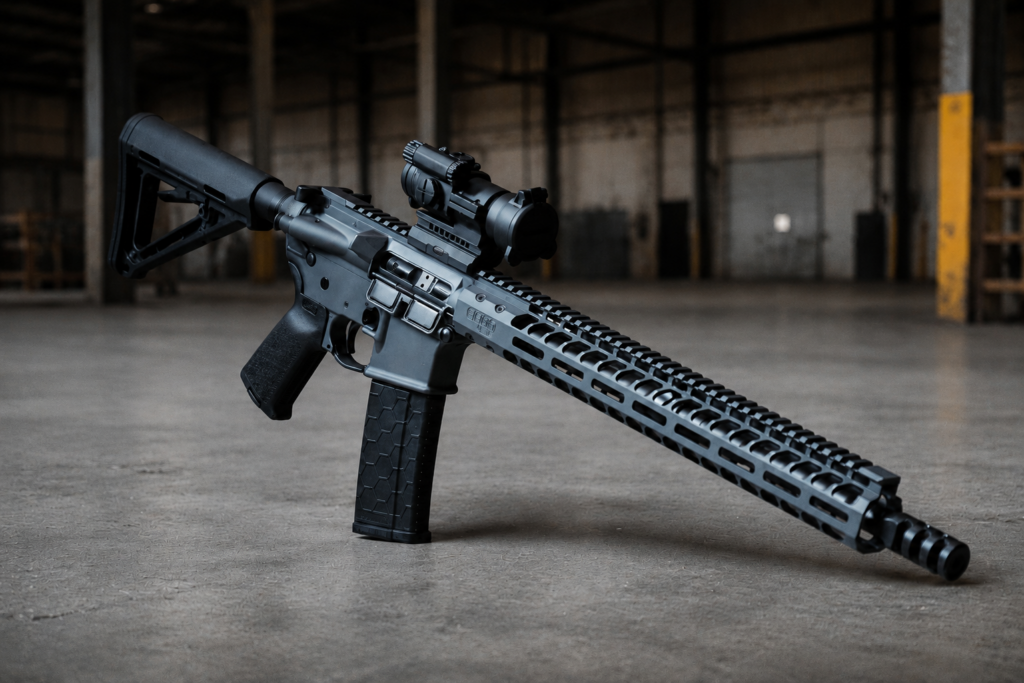
If you are looking for your next AR-15 Rifle, keep an eye on Black Rifle Depot. Black Rifle Depot is in the process of obtaining its FFL and will soon offer complete AR-15 rifles and other firearms, in addition to the parts, components, and accessories customers already know them for.
Shop Black Rifle Depot and get ready for complete AR-15 rifles and firearms coming soon.
Frequently Asked Questions About AR-15 Rifle Barrel Length
Barrel length affects handling, velocity, legal configuration, and component selection, so it naturally creates plenty of questions. Here are answers to some of the most common questions shooters have when comparing these popular configurations.
Is a 16-inch barrel the best length for an AR-15 Rifle?
For many shooters, it is the most versatile option. A 16-inch AR-15 Rifle provides good 5.56 velocity, widespread parts availability, manageable overall length, and the freedom to change removable muzzle devices without relying on them to meet the federal 16-inch barrel threshold.
Is a 14.5-inch AR-15 Rifle legal without registering it as an SBR?
A 14.5-inch barrel alone falls below the federal 16-inch rifle-barrel threshold. However, ATF guidance permits a qualifying permanently attached muzzle device to count toward barrel length. The completed barrel must meet the applicable measurement requirement. Always confirm current federal, state, and local laws before configuring a firearm.
Can you use a 13.9-inch barrel on a standard rifle?
Yes, as long as the completed firearm complies with applicable law. For a conventional non-NFA rifle, 13.9-inch setups commonly rely on a qualifying permanently attached muzzle device that brings the measured barrel length to at least 16 inches.
Because 13.9 inches leaves less barrel length to work with than 14.5 inches, muzzle-device selection becomes especially important.
Is 13.9 better than 14.5?
Neither is inherently better. A 13.9-inch AR-15 Rifle provides slightly more compact handling, while a 14.5-inch barrel gives you a little more velocity and greater flexibility in choosing a muzzle device capable of reaching the required completed length. The 14.5-inch option is generally easier to configure. The 13.9-inch option is attractive when reducing every practical bit of overall length matters.
Does a shorter barrel make an AR-15 less accurate?
No. Barrel length by itself does not determine mechanical accuracy.
Shorter barrels generally produce less velocity, but barrel quality, ammunition, chamber consistency, and manufacturing quality have a much greater influence on group size.
What about a 9mm rifle, 16-inch barrel AR 15?
A 9mm rifle with a 16-inch barrel AR-15 configuration may look similar externally, but 9mm operates very differently from 5.56 NATO. The ballistic advantages and disadvantages of 13.9-, 14.5-, and 16-inch 5.56 barrels should therefore not be directly applied to a 9mm AR. A 16-inch 9mm AR is often selected to meet rifle-length requirements rather than because 9mm requires 16 inches of barrel to perform effectively.
How does a modern AR compare with an M-16 rifle?
The traditional M-16 rifle is associated with a 20-inch barrel and full-length rifle configuration. The 13.9-, 14.5-, and 16-inch configurations discussed here are considerably more compact and fall into what most shooters would consider the carbine or general-purpose rifle category.
Is an SR-16 rifle the same as an AR-15?
No. The SR-16 rifle refers to a specific Knight’s Armament platform, not a generic term for an AR-15. It shares AR-family design heritage, but specific components, configurations, and specifications may differ from a conventional commercial AR-15 Rifle.
How does the MCX-SPEAR LT 5.56 16 rifle compare?
The MCX-SPEAR LT 5.56 16 rifle occupies a similar general-purpose role to a 16-inch AR, but SIG Sauer’s MCX platform uses a different operating system and architecture. It can be useful as a comparison when shopping for a modern 5.56 rifle, but barrel-length conclusions should not be assumed to translate perfectly between the two platforms.
For additional resources and online deals on AR-15 Rifles, check out our X Page.
