
AR-15 Rifles, AR-15 Complete Uppers
AR-15 vs. M16 vs. M4: What Are the Key Differences?
Aug
Table of Contents
The AR-15, M16, and M4 are closely related firearms that share the same basic platform, so people sometimes use the names interchangeably. From a distance, all three can look remarkably similar. They share familiar receiver shapes, controls, magazines, operating principles, and many compatible components.
That does not make them the same rifle.
Understanding the AR-15 vs. M16 vs. M4 comparison requires looking at where each design came from and what it was intended to accomplish. The M16 developed into a full-size military service rifle. The M4 evolved from that platform into a shorter military carbine. The modern AR-15 has become an extremely versatile civilian platform that can resemble either military design—or look completely different.
For AR-15 owners and builders, these differences become especially noticeable when comparing barrel lengths, gas systems, stocks, fire-control systems, and complete upper receivers. A traditional M16 upper, for example, is usually built around a longer rifle configuration, while an M4 upper emphasizes the shorter proportions of a carbine.
Here’s how the AR-15, M16, and M4 compare and what those differences mean when choosing an upper for your own AR-15.
The AR-15 Came First
One of the biggest misconceptions surrounding these rifles is that the AR-15 was created as a civilian version of the M16.
The history actually runs the other way around.
ArmaLite developed the original AR-15 during the late 1950s as a smaller-caliber evolution of Eugene Stoner’s AR-10 design. Colt later acquired the rights to the platform, and continued military development eventually resulted in the rifle that became the M16.
The M16 therefore traces its roots directly back to the AR-15.
As military requirements changed, the Army developed shorter versions of the platform. That evolution ultimately resulted in the M4 Carbine, which retained much of the same operating system and receiver design while dramatically reducing the rifle’s overall size.
The civilian AR-15 market took a different path.
Instead of remaining tied to a single military specification, manufacturers began adapting the platform for everything from recreational shooting and hunting to competition, home-defense configurations, precision shooting, and general-purpose rifles.
That freedom to configure the rifle is one of the biggest differences between a modern AR-15 and the military M16 or M4.
AR-15 vs. M16 vs. M4 Comparison Chart
While individual models and configurations vary, this chart illustrates the major differences between the three platforms.
| Feature | AR-15 | M16 | M4 |
|---|---|---|---|
| Typical Role | Civilian sporting and general-purpose platform | Full-size military service rifle | Compact military carbine |
| Traditional Barrel Length | Varies; 16″ is extremely common | 20″ | 14.5″ |
| Typical Gas System | Carbine, mid-length, rifle or other | Rifle length | Carbine length |
| Stock Style | Fixed or adjustable | Traditionally fixed | Adjustable |
| Fire Control | Typically semi-automatic | Military select-fire configuration | Military select-fire configuration |
| Common Chambering | 5.56 NATO/.223 Rem. plus many others | 5.56 NATO | 5.56 NATO |
| Upper Configuration | Highly customizable | Full-length rifle style | Compact carbine style |
| Handguard Options | Extremely broad | Varies by M16 generation | Varies by M4 configuration |
| Main Advantage | Versatility and customization | Full-length rifle characteristics | Compact handling |
The most important thing to remember is that AR-15 describes a much broader family of configurations, while M16 and M4 identify military rifles with more specific characteristics.
What Is an AR-15?
The modern AR-15 is best understood as a platform rather than one exact rifle.
Two AR-15s can look dramatically different while still sharing the same basic receiver architecture.
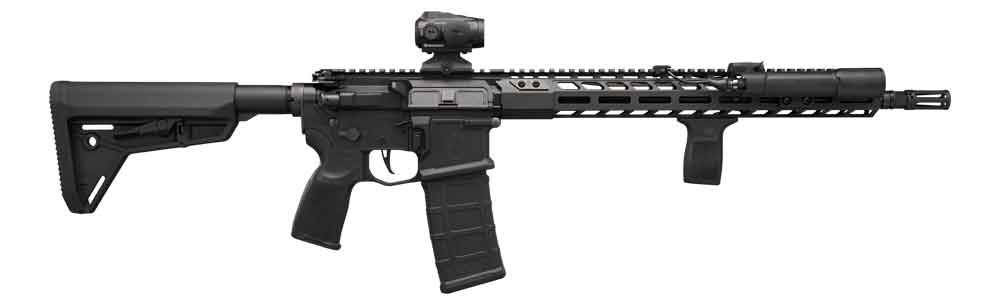
One could have a 20-inch barrel, fixed stock, and rifle-length gas system that gives it the appearance of an M16. Another might feature a shorter carbine-style front end inspired by the M4. A third could have a 16-inch barrel, a mid-length gas system, a low-profile gas block, and a 15-inch free-float M-LOK handguard.
All three can still be AR-15s.
That flexibility is why the civilian AR-15 market offers such a broad range of barrel profiles, gas-system lengths, handguards, muzzle devices, stocks, pistol grips, triggers, sights, optics, and upper receiver assemblies.
Caliber options extend far beyond 5.56 NATO and .223 Remington. Depending on the configuration, AR-pattern rifles can be chambered for a wide range of cartridges.
For someone shopping for a complete upper, this flexibility matters. You do not have to choose between creating an exact M4 or M16 reproduction. You can take features you like from either design and combine them with modern AR-15 components.
What Is the M16?
The M16 is the full-size military rifle in the AR family.
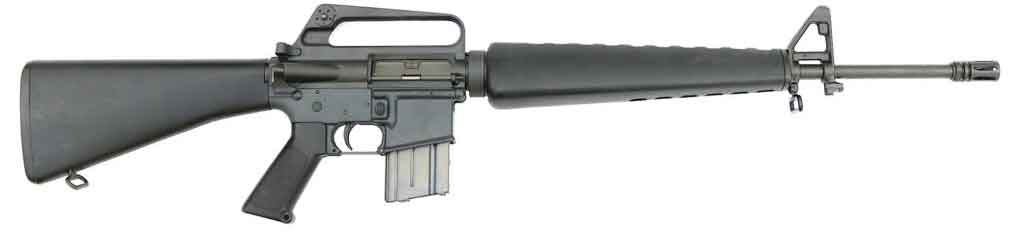
Multiple versions have been developed over the decades, including the M16A1, M16A2, M16A3, and M16A4. Features changed between generations, but the M16 became strongly associated with a 20-inch barrel and full-length rifle configuration.
That longer barrel gives the M16 a noticeably different appearance from the M4.
A traditional M16 configuration also uses a rifle-length gas system. The gas port sits farther forward on the barrel than it would on a carbine-length setup, resulting in different operating characteristics.
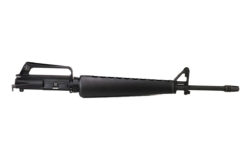
Older versions of the M16 are particularly recognizable because of their fixed stocks, carry handles, triangular or round polymer handguards, and fixed front sight bases. Later versions modernized the platform with flat-top receivers, accessory rails, optics, and other upgrades.
For civilian AR builders, the term M16 upper generally refers to an AR-pattern upper that follows this longer rifle-style configuration.
An M16 upper receiver or M16-style complete upper might therefore include a 20-inch barrel, rifle-length gas system, and traditional front sight assembly or a modern free-float handguard.
Using the term “M16-style” does not mean the completed civilian rifle has the same select-fire capabilities as a military M16.
What Is the M4?
The M4 takes the basic architecture of the M16 family and makes it substantially more compact.
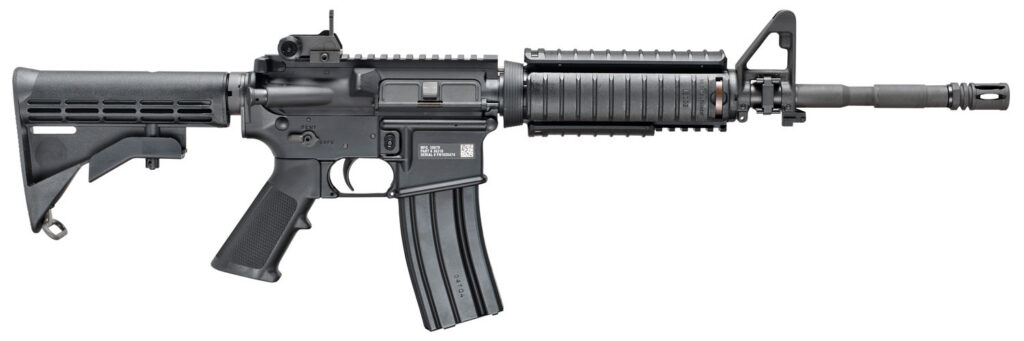
Its most recognizable characteristic is its 14.5-inch barrel. Combined with an adjustable stock and shorter gas system, that reduced barrel length gives the M4 much shorter overall dimensions than a traditional M16.
That difference matters because the M4 was designed around mobility.
A shorter rifle is easier to maneuver around vehicles, inside buildings, and in other areas where a full-size 20-inch rifle can become cumbersome.
The traditional M4 uses a carbine-length gas system rather than the rifle-length system associated with the M16.
Like the M16, however, the actual military M4 is a select-fire firearm. That is an important distinction between an M4 and the civilian AR-15 rifles that are commonly described as “M4-style.”
In the civilian market, an M4-style upper usually refers to an AR-15 upper that borrows the proportions or features of the military carbine.
It does not mean the firearm is an actual military M4.
M4 Upper vs. M16 Upper
For an AR-15 owner, one of the most practical ways to understand the difference between the M4 and M16 is to compare the upper assemblies.
The upper receiver body may look similar, but the surrounding parts create two very different rifles.
An M4 upper generally emphasizes a shorter carbine configuration.
An M16 upper generally emphasizes the longer dimensions of a rifle.
M4 Upper Configuration
A traditional M4-style setup is associated with a:
- Shorter barrel
- Carbine-length gas system
- Compact handguard
- M4-style barrel profile
- Fixed front sight base on traditional configurations
- Flat-top receiver on most modern versions
The military M4 uses a 14.5-inch barrel, but civilian M4-inspired rifles commonly use 16-inch barrels.
That extra length lets manufacturers keep much of the M4’s compact styling while offering a conventional rifle configuration under federal barrel-length requirements.
Another option is a 14.5-inch barrel with a permanently attached muzzle device that makes the legal barrel length at least 16 inches.
As a result, shoppers looking for an M4 complete upper receiver will frequently find 16-inch options alongside 14.5-inch models intended for appropriate configurations.
M16 Upper Configuration
An M16-inspired upper generally uses a longer setup.
Traditional characteristics include:
- 20-inch barrel
- Rifle-length gas system
- Longer handguard
- Fixed front sight base on classic designs
- Full-length rifle proportions
A modern M16 upper receiver assembly doesn’t have to look retro.
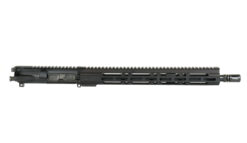
Manufacturers can combine a 20-inch barrel and rifle gas system with a free-float M-LOK handguard, low-profile gas block, modern muzzle device, and flat-top receiver.
That provides the general barrel and gas-system characteristics associated with a full-length rifle without requiring the builder to reproduce a particular military M16 model.
Barrel Length Is One of the Biggest Differences
If you are trying to quickly tell an M16 and M4 apart, start with the barrel.
The basic comparison is:
M16: 20-inch barrel
M4: 14.5-inch barrel
AR-15: Varies widely
The AR-15’s ability to use different barrel lengths is where things become much more interesting.
Sixteen-inch barrels are among the most popular options for civilian AR-15 rifles because they provide relatively compact handling without requiring the rifle to use an extended barrel.
Longer 18- and 20-inch barrels are also available for shooters interested in full-length rifle configurations.
Shorter barrels are widely available as well, though you must always consider the completed firearm’s legal classification.
This variety means an AR-15 can sit between an M4 and M16 or go well beyond either traditional configuration.
How the Gas Systems Compare
Gas-system length is another major part of the AR-15 vs. M16 vs. M4 discussion.
The traditional M16 uses a rifle-length gas system.
The M4 uses a carbine-length gas system.
The AR-15 can use either system, but it can also use a mid-length system.
Mid-length gas systems have become especially common on modern 16-inch AR-15 barrels. They place the gas port farther forward than a carbine system but not as far forward as a rifle-length setup.
This gives today’s AR-15 owner an option that is not defined by either classic military rifle.
A modern 16-inch AR with a mid-length gas system and free-floating handguard is a perfect example of how the civilian platform has evolved independently of its military relatives.
It borrows the same general architecture but doesn’t try to duplicate either the M4 or M16.
AR-15, M16, and M4 Handguards
Handguard design has changed tremendously throughout the life of the AR platform.
Early M16 rifles used simple polymer handguards. The M16A1 became famous for its triangular handguards, while later versions moved toward round designs.
Military M4 configurations originally used shorter polymer handguards surrounding the carbine-length gas system. Rail systems later became common as lights, lasers, vertical grips, and other accessories became more important.
Today’s commercial AR-15 market offers far more variety.
Modern complete upper receivers often use lightweight, free-floating M-LOK handguards that extend most of the way toward the muzzle.
These handguards provide significant accessory mounting space and generally surround a low-profile gas block rather than the traditional fixed front sight base.
As a result, a modern M4-style upper may maintain M4-inspired barrel dimensions without looking much like an older military carbine.
The same applies to M16-style builds. A 20-inch modern upper can preserve the full-length rifle concept while replacing almost every visible feature associated with a traditional military M16.
What Does “M4 Feed Ramps” Mean?
Shoppers comparing AR-15 upper receivers frequently encounter another M4-related term: M4 feed ramps.
Feed ramps help guide cartridges from the magazine into the chamber.
M4-style feed ramps extend slightly farther into the upper receiver than older rifle-style feed-ramp designs. They became associated with carbine configurations but are now extremely common throughout the civilian AR-15 market.
This means an AR-15 upper with M4 feed ramps is not an M4.
Many modern AR-15 rifles with 16-, 18-, or 20-inch barrels use M4-style feed ramps even though the completed rifles share few other characteristics with a military M4.
The term simply refers to that specific feed-ramp geometry.
Fixed Stock vs. Adjustable Stock
Stock design provides another easy visual distinction between classic M16 and M4 configurations.
Traditional M16 rifles use fixed stocks.
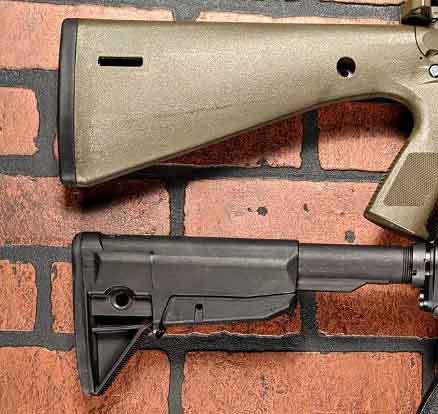
M4 carbines use adjustable stocks.
The shorter adjustable stock contributes to the M4’s compact dimensions and lets you adjust the length of pull for different shooters, equipment, and shooting positions.
Civilian AR-15 owners can choose either style.
A fixed rifle stock can work well with a traditional 20-inch build, while an adjustable stock is common on 16-inch general-purpose rifles.
Modern AR configurations also let you mix these characteristics. A builder could pair a longer upper with an adjustable stock or use other combinations depending on component compatibility and personal preference.
Once again, the AR-15 offers far more flexibility than either military specification.
Fire-Control Differences
One of the most important differences in any AR-15 vs. M16 vs. M4 comparison involves the fire-control system.
Typical civilian AR-15 rifles operate in semi-automatic mode, firing one round for each function of the trigger.
Military M16 and M4 rifles use select-fire systems. Specific modes depend on the model. Different M16 generations have used automatic or burst functions in addition to semi-automatic fire, while the M4 family has also used military select-fire configurations.
This is one area where appearance should not be confused with function.
A civilian AR-15 can look nearly identical to an M4 or M16 while remaining mechanically and legally different in its fire-control configuration.
Likewise, installing an M4-style or M16-style upper on a compatible civilian AR-15 does not turn the firearm into a military M4 or M16.
How Much Parts Compatibility Is There?
One reason the AR family has become so successful is that many components follow common patterns and dimensions.
Depending on the exact components involved, AR-15 rifles may share compatible:
- Upper receivers
- Bolt carrier groups
- Charging handles
- Barrels
- Handguards
- Stocks
- Grips
- Magazines
- Muzzle devices
- Small upper-receiver components
However, that does not mean every part works with every configuration.
Gas-system length must match the barrel setup. Gas blocks must match the barrel’s gas-block journal diameter. Handguards generally require the appropriate barrel nut and mounting system. Barrel extensions and upper receivers should also use compatible feed-ramp configurations.
When buying a complete upper, the manufacturer has already handled much of this component matching.
That is one of the primary reasons an M4 complete upper receiver, or another assembled AR-15 upper, can appeal to builders who want a straightforward starting point.
Which Is Better: AR-15, M16, or M4?
There isn’t really a “best” platform among the three because they serve different purposes.
The M16 represents the traditional full-size service-rifle configuration.
The M4 emphasizes portability and compact handling.
The AR-15 allows the owner to choose the characteristics that make the most sense for a particular rifle.
Someone who likes classic full-size rifles may prefer a 20-inch M16 upper.
Someone interested in a compact general-purpose configuration may prefer an M4 upper or modern 16-inch M4-inspired design.
Many shooters will choose neither.
A 16-inch mid-length AR-15 with a free-float handguard, modern optic, adjustable stock, and low-profile gas block has become an extremely common configuration even though it does not exactly duplicate an M4 or M16.
That customization is arguably the AR-15’s greatest advantage.



Final Thoughts
The AR-15 vs. M16 vs. M4 comparison is easier to understand once you look at the purpose behind each design. The M16 represents the traditional full-size military rifle, while the M4 takes the same basic platform and makes it shorter and more compact. The AR-15 gives civilian shooters much more freedom to choose barrel length, gas system, handguard, stock, and overall configuration.
That flexibility means an AR-15 can closely resemble an M4 or M16, or combine modern features from neither. For most builders, the best choice comes down to how they want the finished rifle to handle and perform.
Whether you are looking for an M4 upper, an M16-inspired setup, or a modern complete upper, shop AR-15 Complete Uppers at Black Rifle Depot to find the right configuration for your next build.
Frequently Asked Questions About the AR-15, M16, and M4
The shared history of these platforms creates plenty of confusion, especially when product names use terms such as M4 upper, M16 upper, and AR-15. Here are quick answers to some common questions.
Is an AR-15 the same as an M16?
No. The platforms are closely related, but an M16 is a military rifle with a specific configuration and select-fire capability. The civilian AR-15 is generally semi-automatic and can be built in a much broader range of configurations.
Is an AR-15 the same as an M4?
No. The M4 is a military carbine based on the same firearm family. A civilian AR-15 can be built to resemble an M4, but that does not make it an actual M4.
What is the main difference between an M16 and an M4?
The most noticeable difference is size. A traditional M16 uses a 20-inch barrel and rifle-length configuration, while the M4 uses a 14.5-inch barrel, carbine-length gas system, and adjustable stock.
Does an M4 upper make an AR-15 fully automatic?
No. An upper receiver assembly does not determine whether an AR-15 has a select-fire military fire-control system. A civilian AR-15 equipped with an M4-style upper remains a civilian AR configuration based on its actual receiver and fire-control components.
Is an M16 upper more accurate than an M4 upper?
Not automatically. Barrel quality, ammunition, barrel profile, manufacturing tolerances, optics, and the shooter all influence practical accuracy. A longer barrel does not automatically mean a rifle will produce smaller groups.
Can an M16 upper be used on an AR-15?
Many M16-style civilian upper assemblies use the same basic AR-pattern receiver dimensions and can be compatible with a standard AR-15 lower. Always check the specific upper and lower for compatibility.
For additional support and online deals, check out our X Page.
