
AR-15 Parts
How to Build an AR-15 Lower: Step-by-Step with a Parts Checklist
Nov
Table of Contents
An AR-15 lower receiver houses several essential firearm control components, including the trigger assembly, safety selector, magazine catch, and bolt catch. Understanding how these components work together is an important part of planning an AR-15 build. For someone researching how to build an AR-15 lower, the priorities are identifying the necessary parts, checking compatibility, and understanding the tools and professional safety inspections involved.
A conventional lower assembly project often takes around one hour for someone familiar with the platform, though experience and component design affect the time required. The stripped lower receiver is the regulated, serialized firearm component and must be acquired through the applicable legal transfer process.
Disclaimer: This article is provided for general educational and editorial purposes only. It is not a substitute for manufacturer instructions, professional gunsmithing services, or legal advice. Firearm components and configurations are subject to applicable federal, state, and local regulations. Always confirm compatibility, comply with applicable laws, and have a qualified professional perform or inspect firearm assembly and safety-critical work.
AR-15 Lower Parts Checklist: Everything You Need
Before beginning an AR-15 lower project, identify every component required for the intended configuration. A standard lower includes the receiver, fire-control components, magazine and bolt controls, receiver pins, grip, and recoil system.
The following checklist covers the major components used in a conventional AR-15 lower. Individual kits vary, so compare their manufacturer-provided contents before purchasing additional parts.
| Part | Qty | Comes in an LPK? | Shop |
|---|---|---|---|
| Stripped lower receiver | 1 | No | Local FFL or licensed retailer |
| Lower parts kit | 1 | Entire kit | Lower Parts Kits |
| Trigger, hammer and disconnector | 1 set | Often | Triggers |
| Safety selector and associated components | 1 set | Often | Safety Selectors |
| Magazine catch assembly | 1 | Often | Magazine Catch |
| Bolt catch assembly | 1 | Often | Bolt Catch |
| Pivot and takedown pins with detents and springs | 1 set | Often | Lower Parts Kits |
| Trigger guard | 1 | Varies | Trigger Guards |
| Pistol grip and associated hardware | 1 | Varies | AR-15 Grips |
| Buffer tube, end plate and castle nut | 1 set | Usually not | Stocks & Buffer Kits |
| Buffer and action spring | 1 each | Usually not | Stocks & Buffer Kits |
| Stock or applicable brace | 1 | Usually not | Stocks & Buffer Kits |
Skip the individual parts search: Black Rifle Depot offers AR-15 Lower Build Kits and Lower Parts Kits for different project requirements. Always review the included components before ordering.
Lower Parts Kit vs. Lower Build Kit: What’s the Difference?
An AR-15 lower parts kit generally contains the small components needed for a conventional lower receiver. In contrast, an AR-15 lower build kit commonly includes additional components such as a receiver extension assembly and stock. Contents vary by manufacturer, so review our AR-15 Lower Parts Kit vs. Lower Build Kit comparison before deciding which option meets your needs.
Tools You’ll Need for an AR-15 Lower Project
A properly equipped workbench helps protect components and allows a qualified installer to follow the manufacturer’s assembly and inspection requirements. Specialized tools reduce the risk of receiver damage and improve the consistency of mechanical work.
Common tools associated with lower receiver projects include:
- AR-15 armorer’s wrench
- Bench vise
- Compatible lower receiver vise block
- Roll pin punches and starter punches
- Nylon or brass hammer
- Calibrated torque wrench
- Pivot pin detent tool
- Manufacturer-approved grease and firearm lubricant
- Safety glasses
A torque wrench and armorer’s wrench serve different purposes, and compatibility depends on the components and tightening requirements. Manufacturer documentation should govern tool selection and use.
Explore the AR-15 Tools collection for armorer’s tools and workbench accessories.
Understanding an AR-15 Lower Assembly Diagram
An AR-15 lower assembly diagram helps identify components and understand their relationships within the receiver. Exploded diagrams typically display each major assembly separately, making them valuable references when comparing parts against a manufacturer’s inventory.
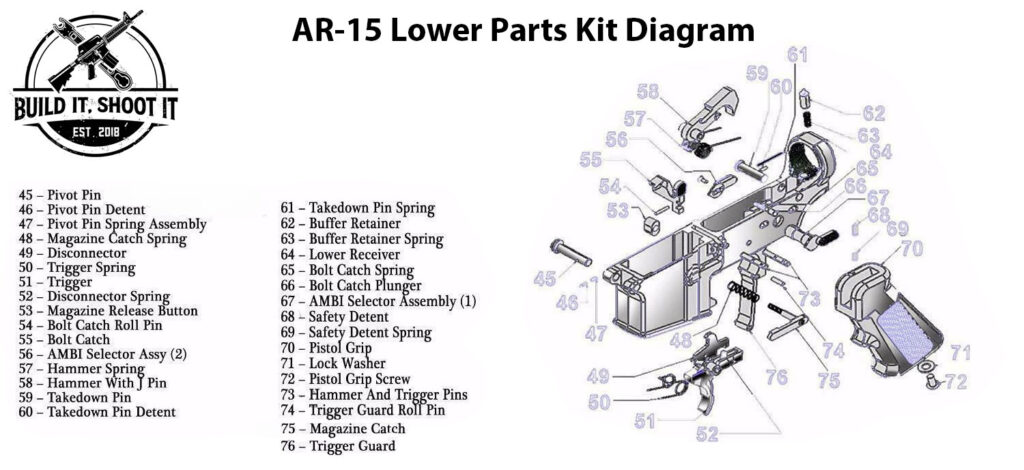
The lower receiver contains several distinct component groups:
| Component group | Purpose |
|---|---|
| Magazine catch assembly | Retains and releases the magazine |
| Bolt catch assembly | Holds the bolt carrier assembly to the rear when engaged |
| Pivot and takedown pins | Connects the upper and lower receivers |
| Trigger guard | Protects the trigger |
| Fire-control group | Contains the trigger, hammer, and associated components |
| Safety selector | Provides the designated safety-control function |
| Pistol grip | Provides the primary firing-hand gripping surface |
| Receiver extension assembly | Houses and supports the recoil system in applicable designs |
| Stock or brace | Provides a configuration-specific rear attachment |
Not every lower receiver uses the same component arrangement. Billet receivers, ambidextrous receivers, and proprietary designs can incorporate different controls or hardware.
For additional terminology, consult the AR-15 Parts Glossary.
How to Build an AR-15 Lower: Understanding the 10 Major Component Groups
Learning to build an AR lower starts with understanding the components, their compatibility requirements, and the areas that require extra attention during professional installation.
The following sections explain the ten major component groups involved in a conventional lower receiver assembly. They are intended for component identification and project planning, not mechanical installation instructions.
1. Magazine Catch Assembly
Parts involved: Magazine catch, magazine catch spring, and magazine release button.
The magazine catch retains a compatible magazine inside the lower receiver. When you activate the release control, the catch disengages, allowing you to remove the magazine.
Standard receivers use familiar magazine release controls, while certain ambidextrous designs provide an additional release option. Enhanced magazine catches may have different external shapes, but compatibility depends on the receiver and the manufacturer’s specifications.
Important consideration: Confirm that the selected magazine catch assembly supports the receiver and its existing control arrangement.
Browse AR-15 Magazine Catch Components.
2. Bolt Catch Assembly
Parts involved: Bolt catch, plunger, spring, and retaining hardware.
The bolt catch retains the bolt carrier assembly in its rearward position when engaged. On a conventional AR-15, it also interacts with the magazine follower to support last-round bolt hold-open operation.
Bolt catch designs include standard controls, extended controls, and components designed for certain ambidextrous receivers.
Important consideration: Small retaining components and the receiver’s exterior finish require particular attention during professional assembly. Receiver-specific hardware requirements take precedence over assumptions based on a conventional forged lower.
Explore AR-15 Bolt Catch Components.
3. Front Pivot Pin Assembly
Parts involved: Front pivot pin, pivot pin detent, and detent spring.
The front pivot pin is one of two main receiver connection pins. It helps secure the upper receiver to the lower while allowing the receivers to separate for normal maintenance.
Some receivers use conventional pivot pins, while others use specialized or proprietary mechanisms.
Important consideration: Compare the receiver manufacturer’s parts requirements against the supplied pins, springs, and detents. Don’t assume all aftermarket receiver designs use identical hardware.
4. Trigger Guard Assembly
Parts involved: Trigger guard and applicable mounting hardware.
The trigger guard surrounds the trigger area and protects against unintended contact. Conventional removable trigger guards are commonly found on forged lower receivers.
Other lowers have an integrated trigger guard machined directly into the receiver. These designs eliminate the need for a separate guard.
Important consideration: Determine whether the receiver uses an integrated or removable trigger guard before purchasing parts. Removable designs may require different mounting hardware.
Shop AR-15 Trigger Guards.
5. Trigger, Disconnector and Hammer
Parts involved: Trigger, hammer, disconnector, springs, and associated retaining pins, as specified by the manufacturer.
The fire-control group is one of the lower receiver’s most important mechanical systems. These components regulate the firearm’s firing and reset functions.
Traditional AR-15 trigger assemblies contain separate internal components, while many aftermarket drop-in triggers use self-contained housings. Some systems require proprietary pins or other manufacturer-specific hardware.
Trigger characteristics vary by product, including pull weight, travel, and whether the system is single-stage or two-stage.
Important consideration: Treat fire-control components as matched, manufacturer-approved systems. Mixing incompatible components can cause unsafe operation.
Compare AR-15 Triggers and read the Mil-Spec AR-15 Trigger Guide for more information about trigger characteristics.
6. Safety Selector and Pistol Grip
Parts involved: Safety selector, selector detent, detent spring, pistol grip, and specified grip hardware.
The safety selector is a principal user-operated control. Conventional semiautomatic AR-15 designs commonly use SAFE and FIRE selector positions.
Aftermarket selectors include ambidextrous configurations, different lever lengths, and alternative actuation angles. Not every selector is compatible with every trigger or receiver.
The pistol grip affects ergonomics, hand positioning, and access to the firearm’s controls. Grip designs differ in angle, texture, size, and storage features.
Important consideration: Verify compatibility between the trigger, safety selector, grip, and receiver before selecting components. The manufacturer should identify any special hardware requirements.
Explore Safety Selectors and AR-15 Grips.
7. Rear Takedown Pin Assembly
Parts involved: Rear takedown pin, detent, and spring.
The rear takedown pin works with the front pivot pin to connect the upper and lower receiver assemblies. This arrangement allows the receiver groups to separate for inspection and maintenance.
Although conventional AR-15 receivers share a common arrangement, some enhanced receivers use different detent retention systems or proprietary pins.
Important consideration: Confirm that the pins and related hardware match the exact receiver model.
8. Buffer Tube, End Plate and Castle Nut
Parts involved: Receiver extension, end plate, castle nut, and any additional components specified by the manufacturer.
The receiver extension, commonly called the buffer tube, is part of the firearm’s recoil system. Depending on the configuration, it also provides an attachment interface for a stock or compatible brace.
Conventional carbine receiver extensions differ from rifle-length and A5-style systems. Evaluate their corresponding buffer and spring requirements together.
Castle nuts, end plates, and receiver extensions must also match the particular receiver design. Use the component manufacturer’s current instructions for installation torque and retention requirements rather than a universal number applied to every product.
Important consideration: Select the receiver extension, buffer, and action spring as a compatible system. Professional installation and inspection are particularly important for components subject to mechanical stress.
Read the AR-15 Buffer Tube Kits Guide: Carbine vs. A5 vs. Rifle.
9. Buffer and Action Spring
Parts involved: Buffer and action spring.
The buffer and action spring are central components of the AR-15 recoil system. Their operating characteristics influence bolt carrier assembly movement during cycling.
Carbine, rifle-length, and A5 configurations have different component requirements. Buffer weights and spring designs also vary within these categories.
A buffer labeled for an AR-15 is not automatically compatible with every AR-15 receiver extension. Specialized configurations require careful attention to the manufacturer’s specifications.
Important consideration: Verify the complete recoil-system configuration rather than buying a buffer or spring based solely on appearance or a generic product designation.
10. Stock or Brace
Parts involved: Compatible stock or brace and any model-specific hardware.
The final rear-attachment selection depends on the intended firearm configuration, applicable laws, and the receiver extension being used.
Adjustable carbine stocks, fixed rifle stocks, and stabilizing braces have different attachment and compatibility requirements.
A conventional adjustable stock designed for a mil-spec carbine receiver extension is not automatically compatible with commercial-dimension or proprietary receiver extensions.
Important consideration: Confirm the manufacturer’s stated fitment and the legal classification of the completed firearm. Changing between a stock and a brace can raise legal issues depending on the firearm’s overall configuration.
For additional information, read How to Install an AR-15 Stock or browse AR-15 Stocks & Buffer Kits.
Video Credit: Pew Tools on YouTube. This video is shared for educational purposes. All credit goes to the original creator.
AR-15 Lower Function Check and Safety Inspection
A completed lower should undergo an appropriate inspection before pairing it with an upper receiver or putting it into service.
The inspection must follow the instructions for the exact trigger, safety selector, receiver, and related components. A qualified gunsmith should verify the following five areas:
- Component identification: All installed components match the documented parts list and approved configuration.
- Receiver integrity: The receiver and accessible components show no apparent cracking, deformation, or installation damage.
- Control compatibility: The trigger and safety selector are approved by their manufacturers for use together.
- Hardware security: Pins, retainers, and other hardware meet the relevant manufacturers’ requirements.
- Functional safety: The complete fire-control and safety systems pass the applicable manufacturer’s inspection and functional testing procedures.
Do not use a lower that fails inspection, shows abnormal control behavior, or contains parts of uncertain compatibility until a qualified professional resolves the issue.
Common AR-15 Lower Build Mistakes to Avoid
Understanding common mistakes helps buyers choose better-matched components and spot issues that require professional attention.
Losing Small Springs and Detents
AR-15 lower parts kits contain small springs, pins, and detents that are easy to misplace. Replace missing or damaged components with the correct manufacturer-specified parts rather than improvised substitutes.
Scratching or Damaging the Receiver
Lower receivers can be scratched or damaged when you use inappropriate tools or work-holding equipment. More importantly, excessive force can damage mounting features or component openings.
Overlooking Trigger Guard Hardware
Some stripped lower receivers include an integrated trigger guard, while others require a separate guard and mounting hardware. Ordering the wrong version can create unnecessary expense or compatibility problems.
Using Incorrect Fastening Specifications
Incorrect tightening or retention practices can damage components or compromise their security. This is particularly important for the receiver extension assembly. Follow the exact manufacturer’s technical documentation and have the finished work inspected.
Mixing Incompatible Buffer System Parts
Carbine, rifle, and A5 receiver extensions have different compatibility requirements. Selecting an incompatible buffer or spring can cause mechanical problems.
Learn more in 9 Common AR-15 Lower Build Kit Mistakes.
Upgrades to Consider While Planning Your Lower
Choosing upgraded components before finalizing a lower parts list can help you avoid buying standard parts you will later replace.
Drop-in triggers: Many aftermarket trigger systems use self-contained housings and offer different pull characteristics from conventional mil-spec-style assemblies. Check receiver compatibility and the manufacturer’s requirements for included hardware.
Ambidextrous safety selectors: Ambidextrous controls provide selector access from both sides of the receiver. Consider lever configuration, trigger compatibility, and receiver clearance.
Enhanced pistol grips: Replacement grips offer different textures, angles, and dimensions. Ergonomic preference is important, but compatibility with the receiver and associated hardware remains essential.
For additional product comparisons, read Best AR-15 Lower Parts Kits of 2026.
Next Step: Pairing Your Lower With an Upper
Once the lower has been professionally assembled and inspected, the next planning consideration is upper receiver compatibility.
AR-15 upper receivers vary in barrel length, caliber, gas-system configuration, and included components. A complete upper may include the barrel, handguard, gas system, and other assembled parts, but not every product includes the bolt carrier group and charging handle.
Confirm upper and lower receiver compatibility using both products’ specifications. The firearm’s finished configuration must also comply with applicable federal, state, and local laws.
Explore AR-15 Complete Uppers and reference the AR-15 Parts Compatibility Chart.
Choosing AR-15 Lower Parts at Black Rifle Depot
A well-planned AR-15 lower project begins with reliable product information and compatible components. Understanding the differences between receiver designs, fire-control systems, lower parts kits, and recoil-system components helps buyers make informed purchasing decisions.
Black Rifle Depot offers AR-15 lower parts kits, build kits, trigger assemblies, safety selectors, grips, and buffer system components for a variety of configurations. Review individual product descriptions and manufacturer documentation to determine which parts meet your project’s requirements.
Whether you’re planning a new lower or comparing replacement components, selecting compatible parts and arranging for proper professional installation and inspection are essential parts of responsible firearm ownership.
AR-15 Lower Build Frequently Asked Questions
The following answers address common questions about lower receivers, parts kits, tools, compatibility, and legal purchasing requirements.
How long does it take to build an AR-15 lower?
A conventional AR-15 lower assembly project often takes one to two hours for someone experienced with the platform. The time required depends on the receiver design, selected components, tools, and necessary inspections. More complex or unfamiliar configurations can take longer.
Do I need special tools to build a lower?
Lower receiver assembly calls for appropriate armorer’s tools and measuring equipment. Common examples include punches, a suitable work-holding fixture, an armorer’s wrench, and a calibrated torque wrench. Exact requirements depend on the receiver and component manufacturers. A qualified gunsmith has the equipment needed to do the work and verify its safety.
Can I build an AR-15 lower without a vise?
A vise isn’t required for every inspection or maintenance task, but proper receiver support matters for mechanical work. Attempting assembly procedures without suitable work-holding equipment can increase the risk of component damage. Consult a qualified gunsmith when the recommended tools are unavailable.
What comes in a lower parts kit?
A conventional AR-15 lower parts kit commonly contains a trigger group, safety selector, magazine catch, bolt catch, pivot and takedown pins, springs, detents, and related hardware. Some kits include a pistol grip and trigger guard, while others omit these parts. Buffer systems and stocks are generally purchased separately unless a more comprehensive kit explicitly includes them.
What torque does an AR-15 castle nut need?
Castle nut torque specifications depend on the receiver extension assembly, hardware, and manufacturer instructions. Don’t apply a single specification indiscriminately to every aftermarket system. Use the current technical documentation for the exact components, and have a qualified gunsmith verify installation and retention.
Do I need an FFL to buy a stripped lower?
A conventional serialized AR-15 stripped lower receiver is regulated as a firearm under federal law. When purchased from a federally licensed dealer, the transfer to an eligible individual is subject to applicable federal and state requirements, including the relevant background-check process. A receiver ordered from an out-of-state retailer is generally sent to an appropriate receiving FFL rather than directly to an unlicensed consumer. State and local restrictions can impose additional requirements.
For additional support and online deals, check out our Instagram Page.