
AR-15 Parts
AR-15 Parts Compatibility Chart
Sep
Table of Contents
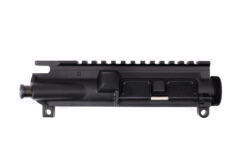
One of the biggest advantages of the AR-15 is its modular design, but that does not mean every AR-15 part fits every AR-15. Compatibility can depend on receiver dimensions, caliber, gas-system length, barrel profile, receiver extension type, and manufacturer-specific designs. “Mil-spec” is also frequently misunderstood: some components follow common AR-15 dimensions, while others—especially commercial receiver extensions and proprietary handguards—require closer attention.
The following AR-15 Parts Compatibility Chart provides a starting point for determining which components can generally be shared between common AR-15 configurations.

AR-15 Parts Compatibility Chart
| AR-15 Part | 5.56/.223 | .300 BLK | .350 Legend | 6.5 Grendel | 7.62×39 AR | Compatibility Notes |
|---|---|---|---|---|---|---|
| Lower Receiver | ✓ | ✓ | ✓ | ✓ | ✓ | Standard AR-15 lowers generally support these calibers |
| Upper Receiver | ✓ | ✓ | ✓ | ✓ | ✓ | Standard AR-15 upper receivers normally work across these configurations |
| Trigger / Lower Parts | ✓ | ✓ | ✓ | ✓ | ✓ | Generally caliber-independent when using standard AR-15-pattern components |
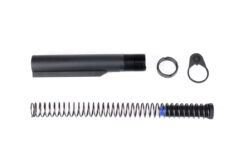
| Buffer Tube | ✓ | ✓ | ✓ | ✓ | ✓ | Must match the stock or brace type and overall operating system |
| Stock | ✓ | ✓ | ✓ | ✓ | ✓ | Mil-spec stocks require mil-spec tubes; commercial stocks require commercial tubes |
| Charging Handle | ✓ | ✓ | ✓ | ✓ | ✓ | Standard AR-15 charging handles are usually interchangeable |
| 5.56 Bolt/BCG | ✓ | ✓ | ✓ | ✗ | ✗ | .300 BLK uses the standard 5.56 bolt; Grendel and 7.62×39 require different bolt faces |
| Barrel | 5.56/.223 | .300 BLK only | .350 Legend only | 6.5 Grendel only | 7.62×39 only | Barrel chamber must match the intended cartridge |
| Gas Block | Usually ✓ | Usually ✓ | Usually ✓ | Usually ✓ | Usually ✓ | Must match barrel gas-block journal diameter |
| Gas Tube | By barrel | By barrel | By barrel | By barrel | By barrel | Pistol, carbine, mid-length and rifle gas systems require matching tube lengths |
| Handguard | Usually ✓ | Usually ✓ | Usually ✓ | Usually ✓ | Usually ✓ | Must fit the upper/barrel nut and provide adequate gas-block and muzzle-device clearance |
| Magazine | 5.56/.223 | Usually ✓ | Caliber-specific recommended | Grendel-specific | 7.62×39-specific | Magazine geometry becomes increasingly important with alternate calibers |
| Muzzle Device | Thread-specific | Thread-specific | Thread-specific | Thread-specific | Thread-specific | Match both barrel thread pitch and projectile diameter |
✓ = Generally compatible when standard AR-15 dimensions are used. Always verify the individual component manufacturer’s specifications before installation.
Mil-Spec vs. Commercial-Spec AR-15 Parts
The terms mil-spec and commercial-spec are commonly associated with the receiver extension, often called the buffer tube.
A mil-spec adjustable stock is designed around a mil-spec-diameter receiver extension. A commercial-spec tube has different external dimensions and usually a different rear profile, so stocks designed for one type may not fit the other.
This distinction does not mean an AR-15 is entirely “mil-spec” or “commercial-spec.” Compatibility should be checked component by component.
When shopping for [AR-15 stocks and buffer kits], verify the receiver extension specification before selecting the stock.


Do All AR-15 Lowers Accept the Same Trigger?
Most modern forged and billet AR-15 lowers designed around standard dimensions accept common AR-15 lower parts, including standard trigger assemblies.
There are exceptions. Certain proprietary receivers, specialized fire-control systems, older designs, and some nonstandard trigger-pin configurations may require specific components. Drop-in triggers can also have clearance or installation requirements that traditional mil-spec-style triggers do not.
For a new build, purchasing compatible AR-15 lower parts or an AR-15 lower parts kit can simplify the process because the small components are intended to work together.
Can You Use a 5.56 BCG With .300 Blackout?
Generally, yes. One major advantage of .300 Blackout is that it uses the same bolt face as 5.56 NATO/.223 Remington.
A shooter converting a standard 5.56 AR-15 to .300 BLK normally changes the barrel while retaining several existing AR-15 components, including the bolt carrier group and charging handle.
The similarity also makes ammunition identification especially important. Never chamber or fire a .300 BLK cartridge in a 5.56 barrel. Clearly identifying magazines, uppers, and ammunition can help prevent dangerous caliber confusion.
By comparison, cartridges such as 6.5 Grendel and 7.62×39 require bolts with different bolt-face dimensions.
Are AR-15 Handguards Universal?
No. Although many [AR-15 handguards and rails] are designed for standard AR-15 upper receivers, the mounting system is a key compatibility factor.
Free-float handguards commonly use their own barrel nut. Anti-rotation tabs must also clear the upper receiver, and the handguard’s internal diameter must allow enough clearance for the gas block or any muzzle device mounted beneath the rail.
Black Rifle Depot’s current handguard selection includes designs with standard and proprietary mounting arrangements, so check barrel-nut and upper-receiver compatibility before ordering.
What AR-15 Parts Change When You Change Calibers?
Changing caliber does not necessarily mean replacing every AR part.
The barrel is the primary caliber-specific component because its chamber and bore must match the cartridge. Depending on the caliber, you may also need a different bolt, magazine, muzzle device, or gas-system configuration.
For example:
- 5.56 to .300 BLK: primarily barrel-related; the standard 5.56 bolt can generally remain.
- 5.56 to .350 Legend: barrel and appropriate magazine are important compatibility considerations.
- 5.56 to 6.5 Grendel: requires a compatible Grendel barrel and bolt, along with appropriate magazines.
- 5.56 to 7.62×39: requires a compatible barrel, bolt, and magazines.
This is why buying AR build parts based only on the words “AR-15 compatible” can cause problems. Evaluate compatibility as a complete system.
Building a Compatible AR-15
Whether you’re buying individual AR-15 gun parts, an AR-15 spare parts kit, or a complete AR-15 parts kit, start with the receiver set and intended caliber. From there, confirm barrel and bolt compatibility, gas-system dimensions, receiver-extension type, handguard mounting system, magazine requirements, and muzzle threads.
Most common AR-15 rifle parts follow widely used dimensions, which is what makes the platform so versatile. However, caliber conversions and proprietary components make compatibility questions more important.
For builders looking for AR-15 parts for sale, Black Rifle Depot carries lower parts, upper components, barrels, bolt carrier groups, handguards, stocks, buffer components, magazines, and other AR-15 parts and accessories for repairs, upgrades, and complete builds.
AR-15 Parts Compatibility FAQ
Compatibility questions are especially common when mixing components from different manufacturers or converting an existing rifle to another caliber. These answers cover several of the most important things to check before purchasing parts.
Are all AR-15 parts interchangeable?
No. Many standard components interchange between AR-15-pattern firearms, but caliber-specific, proprietary, and differently sized components may not.
Are all AR-15 parts interchangeable?
No. Many standard components interchange between AR-15-pattern firearms, but caliber-specific, proprietary, and differently sized components may not.
Can I mix AR-15 parts from different manufacturers?
Usually, as long as the components follow compatible AR-15 dimensions. Check manufacturer-specific barrel nuts, billet receivers, handguards, and other proprietary systems individually.
Do .223 and 5.56 AR-15s use the same parts?
Most components are shared, but chamber specifications matter. Always confirm the barrel is chambered for the ammunition being used.
Does .300 Blackout use standard AR-15 parts?
Many of them. A .300 BLK build normally uses a standard AR-15 receiver set, bolt carrier group, charging handle, and lower components. The barrel must be chambered for .300 Blackout.
Are AR-15 buffer tubes universal?
No. Mil-spec and commercial-spec receiver extensions have different external dimensions, and the stock must match the corresponding tube.
Are AR-15 lower parts caliber-specific?
Most standard lower components are not. Triggers, selectors, takedown pins, grips, and many other lower parts can be used across numerous AR-15 calibers.
Do all AR-15 handguards fit every upper?
No. Check the barrel nut, anti-rotation system, upper-receiver geometry, handguard length, and internal clearance before installation.
Where can I buy AR-15 parts and parts kits?
Black Rifle Depot offers AR-15 parts, upper and lower components, repair parts, build kits, and accessories for a wide range of AR-15 configurations.
For additional support and online deals, check out our X page.
