
Forced Reset Triggers
AR-15 Forced Reset Triggers: Legal Status, How They Work & Buying Guide (2026)
Sep
Table of Contents
The Forced Reset Trigger has become one of the most discussed AR-15 fire-control technologies in recent years. Interest has grown not only because of how these systems function, but also because their federal legal status changed significantly following major court decisions and a 2025 Department of Justice settlement.
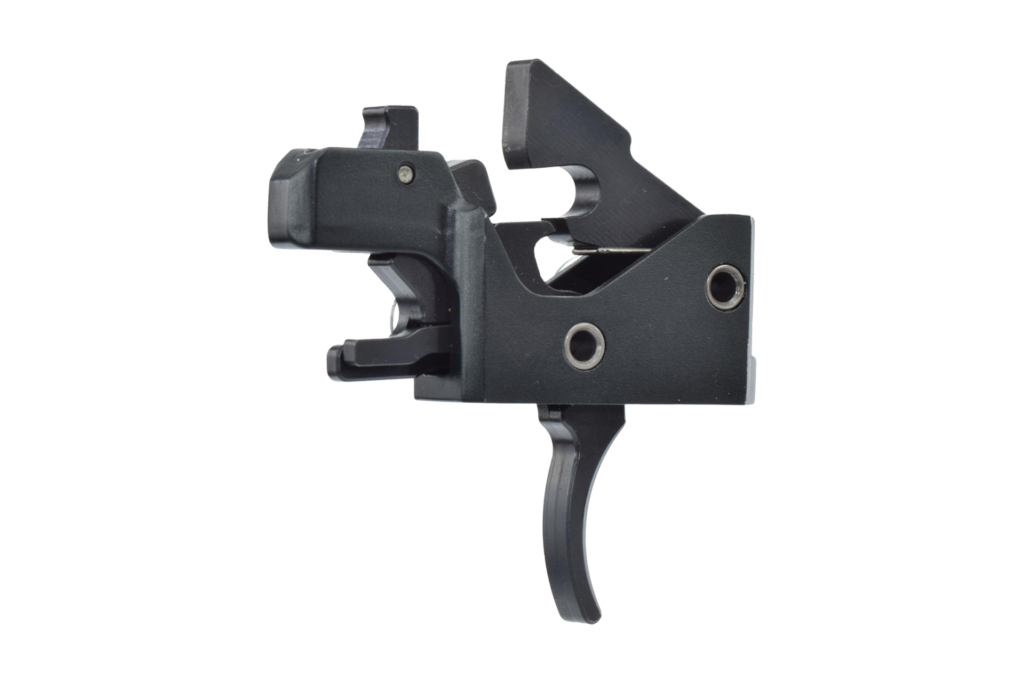
For AR-15 owners, understanding a Forced Reset Trigger requires separating three different questions: how the system mechanically differs from a traditional semi-automatic trigger, how federal law currently treats the technology, and whether state or local restrictions still apply.
Newer designs have also expanded the category beyond complete replacement trigger assemblies. Products such as the Atrius Safety Selector represent selector-based systems that interact with compatible fire-control components rather than simply replacing the entire trigger assembly.
As of 2026, however, legality still depends heavily on location. Federal policy changed considerably between 2024 and 2025, while several states still prohibit or restrict forced-reset and rapid-fire trigger devices regardless of federal law.
Disclaimer: This article is for general informational and educational purposes only and does not constitute legal advice. Firearm laws and regulations can vary by federal, state, and local jurisdiction and may change over time. Always verify current laws and regulations in your area and consult a qualified attorney if you have questions about legality or compliance.
What Is a Forced Reset Trigger?
A Forced Reset Trigger, commonly abbreviated FRT, is a fire-control system designed to mechanically force the trigger forward into its reset position as the firearm cycles.
With a conventional semi-automatic AR-15 trigger, the shooter fires a round, releases pressure enough for the trigger to reset, and then pulls the trigger again to fire another round.
A Forced Reset Trigger accelerates that reset process by using movement created during the firearm’s operating cycle. The trigger is mechanically pushed forward into the reset position, allowing another separate trigger activation to occur more quickly.
That distinction became extremely important during the legal debate surrounding FRTs.
Federal machine-gun law generally focuses on whether a firearm fires more than one shot automatically through a single function of the trigger. Federal courts examining eligible FRT systems concluded that the relevant devices required separate trigger functions for successive shots rather than firing multiple rounds through one trigger pull.
For shooters comparing a forced-reset trigger vs. a binary trigger, the systems should also not be treated as interchangeable.
A binary trigger generally fires:
- One round when the trigger is pulled.
- Another round when the trigger is released.
A forced-reset system instead mechanically assists or forces the trigger’s reset during the cycling process.
A conventional semi-automatic trigger, binary trigger, and Forced Reset Trigger therefore use different mechanical approaches even though each may increase the speed at which experienced shooters can fire compared with an ordinary semi-automatic trigger.
How Does a Forced Reset Trigger Work?
At a basic mechanical level, a Forced Reset Trigger uses movement generated by the firearm’s cycling action to force the trigger back toward its reset position.
When an AR-15 fires, the bolt carrier travels rearward as part of the operating cycle. In a traditional trigger system, the shooter’s trigger finger must allow the trigger to move forward far enough to reset before another shot can be fired.
A forced-reset system uses mechanical interaction between the fire-control components and the cycling action to speed up that process.
The key distinction is that the trigger resets, rather than remaining continuously activated while multiple rounds automatically fire.
This distinction formed a major part of the litigation over whether certain forced reset designs satisfied the federal statutory definition of a machine gun.
The U.S. District Court for the Northern District of Texas ruled on July 23, 2024, that the Rare Breed FRT-15 and Wide Open Trigger at issue in the litigation were not machine guns under the National Firearms Act. ATF’s current guidance expressly acknowledges that decision.
Forced Reset Trigger vs. Standard AR-15 Trigger
A traditional AR-15 trigger relies primarily on the shooter releasing the trigger enough after every shot for the trigger and disconnector to reset.
A Forced Reset Trigger mechanically accelerates this reset process.
That difference can create a dramatically different shooting experience, but a forced-reset design shouldn’t automatically be viewed as a lighter or more refined conventional trigger.
Many premium AR-15 triggers are designed around characteristics such as:
- Reduced trigger pull weight
- Minimal creep
- Short reset
- Crisp break
- Predictable overtravel
- Competition-oriented control
A forced-reset system serves a different purpose. Its defining characteristic is how it resets the trigger during cycling.
That distinction is important when evaluating the best forced-reset trigger for a particular application. A product intended to create forced-reset functionality should not necessarily be compared directly with a match-grade single-stage or two-stage trigger based solely on pull weight or break characteristics.
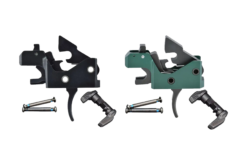
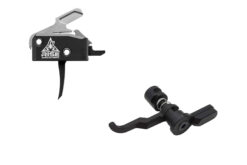
Complete Forced Reset Triggers vs. Selector-Based Systems
One of the biggest changes in this market has been the emergence of systems that approach forced-reset functionality differently.
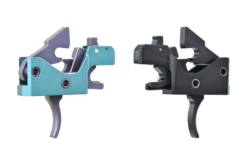
Traditional products generally use a dedicated trigger assembly.
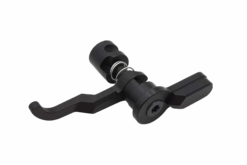
Selector-based systems such as the Atrius Safety Selector, which Atrius calls a Forced Reset Selector (FRS), use the safety-selector area as part of the operating mechanism.
Atrius states that its system is designed around compatible AR-15 fire-control components and that compatibility varies depending on trigger geometry, bolt-carrier configuration, lower-receiver dimensions, and other parts.
This distinction matters when comparing a traditional Forced Reset Trigger with an Atrius Safety Selector.
A complete forced-reset trigger may replace much of the original fire-control group. A selector-based forced-reset system instead integrates its operating mechanism with compatible trigger and selector components.
The Atrius Safety Selector therefore falls under the broader forced-reset category without necessarily matching every traditional FRT design.
Consumers researching terms such as Atrius ambidextrous forced reset selector, Atrius Dev Super Selector, or Atrius forced reset selector review should pay particular attention to manufacturer compatibility information rather than assuming that every AR-15 configuration will interact with the system identically.
Atrius Safety Selector and Compatibility
The Atrius Safety Selector has attracted attention partly because of its selector-based approach.
According to Atrius, its Forced Reset Selectors are designed around specific fire-control and receiver requirements. The company notes that trigger-bar geometry and other component dimensions can affect compatibility.
That makes compatibility one of the most important considerations when evaluating an Atrius Safety Selector.
AR-15 components may generally follow common dimensional standards, but tolerances can vary between manufacturers. Aftermarket triggers, cassette triggers, proprietary bolt carriers, unusual receiver designs, and bufferless operating systems can also differ significantly from traditional AR-15 configurations.
For that reason, someone researching an Atrius Safety Selector should verify:
- The exact firearm configuration.
- Trigger compatibility.
- Receiver compatibility.
- Bolt-carrier requirements.
- Manufacturer specifications.
- Current federal, state, and local law.
The manufacturer maintains compatibility and technical-support information for its forced-reset selector systems.
Any firearm-component installation or modification should also preserve proper safety-selector operation and should be inspected by a qualified gunsmith when compatibility or safe function is uncertain.
Is a Forced Reset Trigger Legal in 2026?
At the federal level, the legal environment surrounding eligible FRTs changed dramatically beginning in 2024.
On June 14, 2024, the U.S. Supreme Court decided Garland v. Cargill, holding that ATF had exceeded its statutory authority when it classified bump stocks as machine guns under the existing federal definition.
Although Cargill involved bump stocks rather than forced reset triggers, the decision became highly relevant to subsequent FRT litigation.
On July 23, 2024, the U.S. District Court for the Northern District of Texas held that the Rare Breed FRT-15 and Wide Open Trigger involved in National Association for Gun Rights v. Garland did not meet the federal machine-gun definition.
ATF now acknowledges that ruling on its official FRT guidance page.
Then, in May 2025, the Department of Justice reached a settlement resolving multiple lawsuits concerning the federal government’s treatment of forced reset triggers.
DOJ stated that the settlement resolved litigation including:
- National Association for Gun Rights v. Garland
- United States v. Rare Breed Triggers
- Related federal litigation involving seized devices
As part of the agreement, Rare Breed also agreed not to develop or design FRTs for use in pistols and agreed to enforce certain patents related to the technology.
As of September 2026, ATF’s published guidance recognizes the federal court ruling that the covered FRT-15 and WOT devices are not machine guns under the NFA.
However, that does not mean every forced-reset-style product is automatically legal in every configuration or jurisdiction.
Do Forced Reset Triggers Require an NFA Tax Stamp?
An eligible Forced Reset Trigger that does not meet the federal definition of a machine gun is not treated as an NFA machine gun simply because it uses forced-reset technology.
Consequently, the covered FRT devices addressed by the court decision and DOJ settlement are not subject to machine-gun registration or a machine-gun tax stamp merely because they are eligible forced reset triggers.
That does not eliminate other federal firearm laws.
A firearm itself may still be regulated under the National Firearms Act based on unrelated characteristics, such as its configuration. Additionally, the ATF notes that the FRT settlement does not extend to actual machine-gun conversion devices, including auto sears, lightning links, switches, or similar conversion components.
This distinction matters for anyone researching a 3-position Forced Reset Trigger or selector-based system.
The number of selector positions alone does not determine whether a firearm is a machine gun. What matters is how the fire-control system actually functions and how applicable federal and state laws classify that operation.
State Forced Reset Trigger Laws Still Matter
Federal legality is only half of the equation.
ATF explicitly warns that some states independently prohibit forced reset triggers or related trigger-activating devices.
California provides one of the clearest examples.
The California Department of Justice states that FRTs are prohibited as “multiburst trigger activators” under California law. California Penal Code Section 32900 prohibits possession, sale, offering for sale, manufacture, importation, giving, or lending of covered devices.
In April 2026, California DOJ further announced that ATF had agreed not to return seized FRTs into California and other jurisdictions where the devices are prohibited under state law.
Other states have enacted laws addressing rapid-fire activators, trigger activators, forced reset systems, or comparable devices. Current restrictions include California, Oregon, Minnesota, New York, Massachusetts, Washington, Maryland, New Jersey, and others, but exact statutory definitions differ considerably.
This is why a Forced Reset Trigger can be permissible under current federal treatment while remaining prohibited under state law.
Before acquiring, possessing, transporting, or transferring any such component, buyers should verify the laws where they live rather than relying exclusively on federal guidance or a retailer’s description.
What Should Buyers Consider Before Choosing a Forced Reset System?
People researching a Forced Reset Trigger for sale often begin by comparing brands or configurations, but legality should come before product comparison.
Important considerations include:
Local legality: Determine whether state or municipal law prohibits forced-reset systems, rapid-fire activators, multiburst trigger activators, or similar components.
System type: Determine whether the product is a complete trigger assembly or a selector-based system such as the Atrius Safety Selector.
Compatibility: Not every forced-reset system works with every AR-15 configuration.
Manufacturer documentation: Product compatibility, operating requirements, and safety guidance should come from the manufacturer, not assumptions based on another AR-15.
Firearm condition: Fire-control components should function safely and correctly before use.
Future legal changes: Forced reset litigation has already produced major policy changes in only a few years. Buyers should not assume today’s federal position can never change.
Searches for terms such as best Forced Reset Trigger, Forced Reset Trigger brands, Forced Reset Trigger price, or Atrius Safety Selector should include legal and compatibility research.
The least expensive or most aggressively marketed system is not automatically the most appropriate choice.
Could Forced Reset Trigger Laws Change Again?
Yes.
The history of the Forced Reset Trigger demonstrates exactly how quickly firearm regulations can change.
The timeline moved from aggressive ATF enforcement, to major litigation, to the 2024 federal court ruling, and finally to the DOJ settlement in 2025.
States subsequently brought additional litigation over the federal government’s plans to return previously seized FRTs.
By April 2026, ATF had agreed that seized FRTs would not be returned into states where possession was prohibited under applicable state law.
Future congressional legislation, state legislation, federal litigation, or another Supreme Court decision could again affect how these devices are regulated.
For that reason, any article claiming that a Forced Reset Trigger is “legal everywhere” would be misleading.
The more accurate statement in 2026 is that eligible FRTs covered by the current federal legal framework are not presently treated as machine guns under federal law, while significant state-level restrictions remain.
Final Thoughts on AR-15 Forced Reset Triggers
The Forced Reset Trigger market looks very different in 2026 than it did only a few years ago. The 2024 federal court ruling and 2025 DOJ settlement significantly changed the federal treatment of eligible FRTs, while newer options such as the Atrius Safety Selector have expanded the category beyond traditional replacement trigger assemblies.
Legality should still come first. A forced-reset system may not be classified as a machine gun under current federal law, but state or local regulations may still restrict or prohibit it.
For shooters researching where to buy a Forced Reset Trigger, Black Rifle Depot offers AR-15 fire-control enhancement products, including select Atrius Safety Selector options where legally available. Before purchasing, verify compatibility with your AR-15 and confirm that possession and use are permitted under current laws in your area.
Shop Black Rifle Depot for available Forced Reset Trigger and fire-control enhancement options for your next AR-15 build or upgrade.
Forced Reset Trigger FAQ
Forced reset trigger laws and technology can be confusing because federal classifications and state restrictions do not always match. These answers address some of the most common questions AR-15 owners have in 2026.
What is the federal legal status of AR-15 forced reset triggers in 2026?
Eligible forced reset triggers addressed by the 2024 federal court ruling and 2025 DOJ settlement are not currently treated as machine guns under federal law. ATF acknowledges the July 23, 2024 court decision involving the Rare Breed FRT-15 and Wide Open Trigger. State restrictions can still apply.
How did the 2024 court ruling and 2025 DOJ settlement change the legal status of forced reset triggers?
The July 2024 Northern District of Texas decision held that the covered FRT-15 and WOT devices were not machine guns under the National Firearms Act. DOJ subsequently settled with Rare Breed in May 2025, resolving several related cases and ending the federal government’s prior enforcement position toward the eligible devices covered by the agreement.
Which states still ban or restrict forced reset triggers in 2026?
Several states continue to restrict forced reset triggers or broader categories such as rapid-fire or multiburst trigger activators. Examples include California, Oregon, Minnesota, New York, Massachusetts, Washington, Maryland, and New Jersey. Definitions and restrictions vary widely, so check current state statutes and official state guidance before possession or transfer.
Do forced reset triggers require NFA registration or a federal tax stamp in 2026?
Eligible FRTs that fall within the current court ruling and federal settlement are not treated as machine guns simply because they use forced-reset technology. Therefore, they do not require machine-gun NFA registration or a tax stamp solely on that basis. Other firearm characteristics can independently trigger NFA requirements.
How does a forced reset trigger differ from a binary trigger and a standard AR-15 trigger?
A conventional semi-automatic trigger requires the shooter to release and reset the trigger after each shot. A Forced Reset Trigger mechanically forces or assists the trigger into its reset position during cycling. A binary trigger typically fires one round when the trigger is pulled and another when it is released.
Why are forced reset triggers treated differently from machine guns under current federal law?
The federal dispute has centered on whether more than one round fires automatically through a single trigger function. The 2024 federal court ruling concluded that the FRT devices before the court did not satisfy that definition.
What should buyers check before purchasing a forced reset trigger for an AR-15 in 2026?
Check current federal, state, and local law first. Buyers should then verify that the specific system is compatible with their firearm and review current manufacturer documentation. A federal legal classification does not override an independent state prohibition.
What is the difference between a complete forced reset trigger and a forced-reset selector system?
A traditional Forced Reset Trigger generally incorporates a dedicated trigger assembly. A forced-reset selector system such as the Atrius Safety Selector uses selector-related components that interact with compatible fire-control parts to create the forced-reset function. Atrius publishes separate compatibility requirements for its system.
Can a federally legal forced-reset trigger still be illegal under state or local law?
Yes. California is a clear example. Although the federal government’s treatment of eligible FRTs changed after the court ruling and DOJ settlement, California still classifies FRTs as prohibited multiburst trigger activators.
Could the legal status of forced reset triggers change again after the 2025 DOJ settlement?
Yes. Federal or state legislation, additional court decisions, or future regulatory changes could affect the legal landscape. Because FRT policy changed substantially between 2022 and 2026, owners and prospective buyers should verify current law rather than relying on older articles or product descriptions.
For additional support and online deals, check out our X Page.
